Walk-In Clinic in Railay
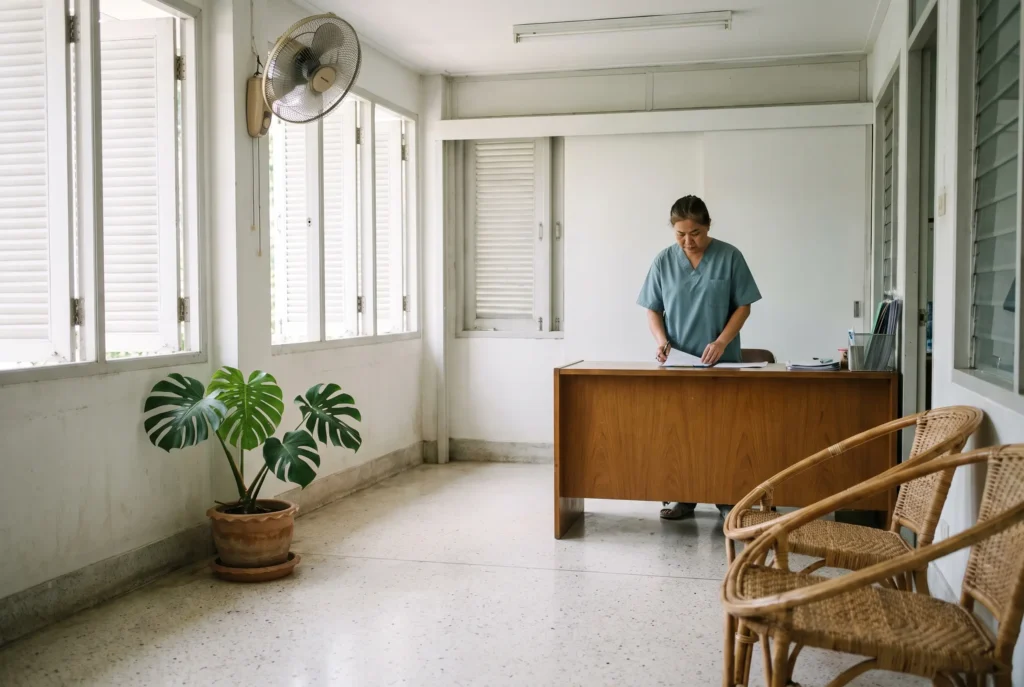
You do not need an appointment, a referral, a Thai address or travel insurance to be seen here. You need to turn up. A walk-in clinic in Railay matters more than it would in a town with roads, because the alternative is a boat, and the boat is why people leave things three days longer than they should.
What walking in actually involves
Come to the door between 8am and 10pm. Someone will ask what has happened and take a look, usually within a few minutes — there is no triage desk, no form to fill in first, and no queue system to understand.
Bring your passport if it is handy, though you will be treated without it. If you take regular medication, bring the box rather than trying to remember the name, because Thai brand names differ from the ones you know and the box removes the guesswork entirely.
If you are coming for a child, know their rough weight. Almost every paediatric dose is calculated by weight, and a good estimate saves a lot of back-and-forth.
Who you will see
Experienced English-speaking nurses run this clinic. We would rather say that plainly on the way in than have you discover it at the door and feel misled.
For the overwhelming majority of what a peninsula like this produces — wounds, stings, fevers, stomach trouble, dressings, injections, blood draws — that is exactly the right level of care, and it is quicker than a system where everything waits for a doctor’s diary.
When your case genuinely needs a doctor, one is brought in rather than approximated. We share doctors with our Ao Nang clinic, so that can mean a case reviewed and a prescription issued within minutes, or a doctor crossing to Railay in person when being physically present is what the situation calls for.
The things that walk through the door most
In rough order of frequency: cuts and grazes from limestone, which is sharper than it looks and dirtier than it looks; sea urchin spines; ear infections after several days of swimming; stomach upsets; sunburn that went beyond uncomfortable; and fevers that need a dengue test rather than a paracetamol.
Then the climbing set: finger injuries, rope burns, ankles from ground falls, and hands opened up on sharp rock.
Alongside that, a steady stream of things that are not emergencies at all — a dressing that needs changing, stitches out on schedule, a prescription replaced after a dry bag turned out not to be dry.
What we can do in one visit
Most problems are opened and closed the same visit. We can clean and close wounds with stitches or glue, run blood tests with results the same visit rather than the next day, put up an IV drip for someone who cannot keep fluids down, remove foreign bodies, and start rabies vaccination the same day after an animal bite.
Same-visit blood results are the part people underestimate. On a peninsula, “come back tomorrow for the result” is not a minor inconvenience — it is a boat, or a day of waiting while something either settles or does not.
What it costs, and when you find out
A basic consultation is inexpensive. Anything beyond it is priced and quoted to you before it happens, so there is no moment at the end where the number is a surprise.
Payment is at the end of the visit, by cash or card. You leave with an itemised receipt and an English medical report, which between them are what nearly every travel insurer wants to see.
Mention insurance at the start rather than the end. It changes what paperwork we produce while you are still in the room, and chasing documents after you have flown home is considerably harder than printing them now — see travel insurance claims.
When walking in is the wrong move
Some things should not walk anywhere. Chest pain, breathlessness at rest, stroke symptoms, a head injury with vomiting or confusion, uncontrolled bleeding, or anyone who cannot be woken: call 1669 and call us at the same time.
Two calls in parallel beats two in sequence. While the ambulance is being tasked on the Ao Nang side, we can be arranging the boat from this side, and the two meet in the middle instead of one waiting on the other — see evacuation and hospital transfer.
The other case is simple inability to walk. If getting here is the actual problem, do not attempt it; ask for a visit instead.
Hours, and why the last boat matters
We are open 8am to 10pm, seven days a week, and contactable outside those hours by phone, WhatsApp and Line.
That evening window exists because of how Railay runs. Climbers come off the rock at dusk, and that is when the day’s accumulated damage gets noticed — the finger that was manageable at noon, the ankle that has stiffened, the cut that has started to look angry.
It matters in the other direction too. Longtail boats thin out after dark and stop altogether in rough weather, so a problem that looks like it can wait until morning is worth a message tonight. Being told it can wait costs you nothing; discovering at 6am that you needed to move last night costs you a great deal.
Frequently asked questions
Do I need an appointment?
No, and there is no appointment system to opt into. Turn up between 8am and 10pm.
How much does a consultation cost?
A basic consultation is inexpensive, and anything beyond it is quoted before it is done. You will not be handed an unexpected number at the end.
Do you speak English?
Yes. The clinic is staffed by experienced English-speaking nurses, and almost all of our patients are visitors rather than Thai residents.
Can I be treated without my passport?
Yes. Bring it if it is easy, but nobody is turned away for not having it.
Can you come to my resort instead?
Yes — ask for a doctor resort visit. On a peninsula with no vehicles, being unable to walk is a genuine obstacle rather than a preference.
What if I need something you cannot do here?
We stabilise you, call the hospital in Krabi Town ahead so they are expecting you, and arrange the boat and the ambulance so they connect. That is evacuation and hospital transfer.
Are you open on weekends and holidays?
Yes, seven days a week including Thai public holidays. Railay does not have a quiet season for injuries.
Who treats you here, and who is behind them
The clinic on Railay is run by experienced English-speaking nurses. Behind them sits Doctor Ao Nang Takecare Medical Clinic in Ao Nang, which Takecare Clinic Railay works together with as one service rather than two businesses: shared doctors, shared records, shared treatment plans. In practice that means a doctor is pulled in the moment your case needs one — to review it, to prescribe, or to come across to the peninsula in person. If you later cross to the mainland, whoever sees you is already holding your notes and you are not starting the story again. It also means the second opinion that would otherwise cost you a boat and half a day costs a phone call.
Getting seen
Opening hours are 8am–10pm daily. Outside them we are still reachable 24 hours by phone, WhatsApp and Line, so when something happens at eleven at night the right move is to message us, not to lie awake deciding whether it can wait. No appointment is needed at any point — walk in, or reach us on +66 81 718 9080, WhatsApp or Line. If you would rather not move, ask for a doctor resort visit and we will come to you. And if this turns out to be something the peninsula cannot handle, that call is also how the boat and the hospital transfer start moving.