Blood Tests in Railay
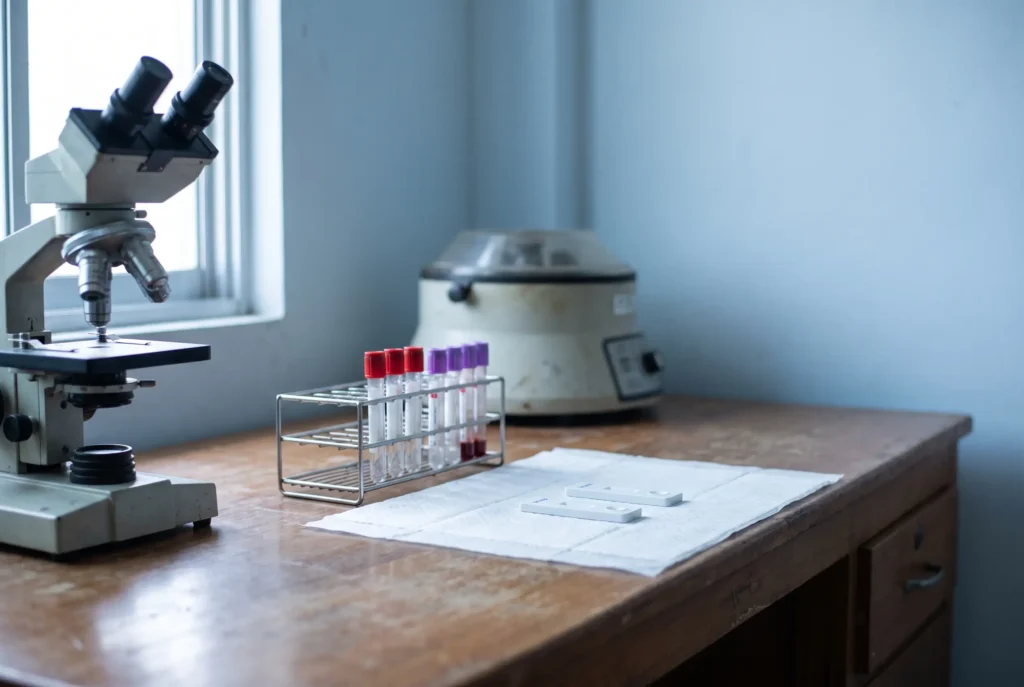
On a peninsula reached only by boat, “come back tomorrow for your results” is not a minor inconvenience — it is a crossing, or a day of waiting while something either settles or gets worse. Blood tests in Railay are run here with results in the same visit for the ones that matter urgently, which is the whole point of having a laboratory on this side of the water.
What we can run, and how fast
Same visit, in roughly fifteen to thirty minutes: dengue NS1 antigen and antibodies, malaria, full blood count, blood glucose, and pregnancy testing.
Within a few hours to a day: liver function, kidney function, electrolytes, inflammatory markers such as CRP, thyroid function, and cholesterol.
Sent to Krabi for specialist analysis: hormone panels, autoimmune screens, cultures and anything unusual. Those take longer and we will tell you honestly how long rather than guessing optimistically.
Why the full blood count matters more here
It is the single most useful test in a tropical clinic, and it is fast and cheap.
White cells indicate whether an infection is likely bacterial or viral, which decides whether antibiotics help or merely cause side effects. Platelets are the number that matters in dengue — a falling platelet count is the marker that turns an unpleasant fever into something needing hospital admission, and you cannot see it by looking at somebody.
Haemoglobin picks up anaemia and blood loss. Together, those three numbers reframe a great many consultations, and they are available before you have finished a cup of water.
Fever in the tropics is a test, not a guess
Any fever over 38C lasting more than a day or two here deserves a blood test rather than a paracetamol and optimism.
The reason is that the things it might be look identical at the start. Dengue, a bacterial infection, a urinary tract infection and early cellulitis all begin as “I feel awful and I have a temperature”, and they need completely different treatment.
Getting dengue wrong has a specific hazard: ibuprofen and aspirin thin the blood and are actively dangerous in dengue, where platelets are already falling. Anyone taking those for what they assume is flu is doing precisely the wrong thing, and a fifteen-minute test settles it.
Tests before diving, climbing seasons and long stays
Divers occasionally need bloods for a medical certificate, and we can do both together — see medical certificates.
People staying a season often want a baseline: liver and kidney function, cholesterol, blood sugar and thyroid. It is a sensible thing to have on record somewhere accessible if you are living several boat rides from a hospital, and it occasionally turns up something worth knowing about early.
Anyone on long-term medication that requires monitoring — thyroid replacement, some blood pressure drugs, anything affecting the kidneys — can have that monitoring done here rather than interrupting a trip to fly home for it.
How the visit works
Walk in. No appointment, no referral, and no need to have been told to come by anyone.
Most tests do not need fasting. Cholesterol and fasting glucose do, which means eight to twelve hours without food — water is fine and encouraged. If you turn up unfasted for those, we will tell you rather than running them and producing a number that means nothing.
The draw itself takes a couple of minutes from a vein in the arm. Tell us if you have ever fainted having blood taken, which is common and entirely manageable if we know beforehand and lie you down rather than after you are on the floor.
One local detail worth mentioning: come hydrated if you can. Several days of heat, sweating and enthusiastic drinking make veins harder to find, and a dehydrated arm turns a two-minute job into an uncomfortable one with more than one attempt. A large glass of water half an hour beforehand genuinely helps, and it does not interfere with fasting.
Getting the results, and taking them with you
Rapid results are given to you in the room. Others come by message or a call, or you come back in, whichever you prefer.
You leave with a printed English report showing the values, the reference ranges and what they mean. That matters for two reasons: your insurer will want it, and any doctor you see afterwards — in Krabi, at home, or on the next stop of your trip — can read it without needing a translation.
If anything is abnormal, you will be told what it means and what to do about it rather than handed a sheet of numbers. Where something needs following up beyond what the peninsula can offer, that is arranged rather than mentioned.
What happens when a result is bad
Occasionally a result changes the plan entirely — platelets low enough that dengue needs monitoring in hospital, an infection marker high enough that oral antibiotics will not be sufficient, kidney function poor enough that the IV fluids we were about to give need rethinking.
In those cases the useful thing is that we already know before you leave. We stabilise, call ahead to Krabi Town so the receiving hospital is expecting you, and arrange the boat — see evacuation and hospital transfer.
The alternative, on a peninsula, is finding out two days later. That is precisely the gap this laboratory exists to close.
Frequently asked questions
How long do results take?
Dengue, malaria, full blood count, glucose and pregnancy tests come back in about fifteen to thirty minutes. Liver, kidney and thyroid panels take a few hours to a day.
Do I need to fast?
Not for most tests. Cholesterol and fasting glucose need eight to twelve hours without food, though water is fine.
Do I need a referral?
No. Walk in and ask — you do not need to have been sent by anyone.
How much do blood tests cost?
It depends which tests, and you are quoted before anything is taken. A full blood count is inexpensive.
Can I get a printed report for my insurer?
Yes — an English report with values and reference ranges, which is what insurers and other doctors need.
I have a fever. Which test do I need?
Usually a dengue test and a full blood count together. Those two answer most tropical fevers, and both are same-visit.
I faint when I have blood taken. Is that a problem?
Not at all, but tell us first. We will lie you down for the draw, which prevents it rather than dealing with it afterwards.
Who treats you here, and who is behind them
The clinic on Railay is run by experienced English-speaking nurses. Behind them sits Doctor Ao Nang Takecare Medical Clinic in Ao Nang, which Takecare Clinic Railay works together with as one service rather than two businesses: shared doctors, shared records, shared treatment plans. In practice that means a doctor is pulled in the moment your case needs one — to review it, to prescribe, or to come across to the peninsula in person. If you later cross to the mainland, whoever sees you is already holding your notes and you are not starting the story again. It also means the second opinion that would otherwise cost you a boat and half a day costs a phone call.
Getting seen
Opening hours are 8am–10pm daily. Outside them we are still reachable 24 hours by phone, WhatsApp and Line, so when something happens at eleven at night the right move is to message us, not to lie awake deciding whether it can wait. No appointment is needed at any point — walk in, or reach us on +66 81 718 9080, WhatsApp or Line. If you would rather not move, ask for a doctor resort visit and we will come to you. And if this turns out to be something the peninsula cannot handle, that call is also how the boat and the hospital transfer start moving.