Sprained ankle treatment in Railay
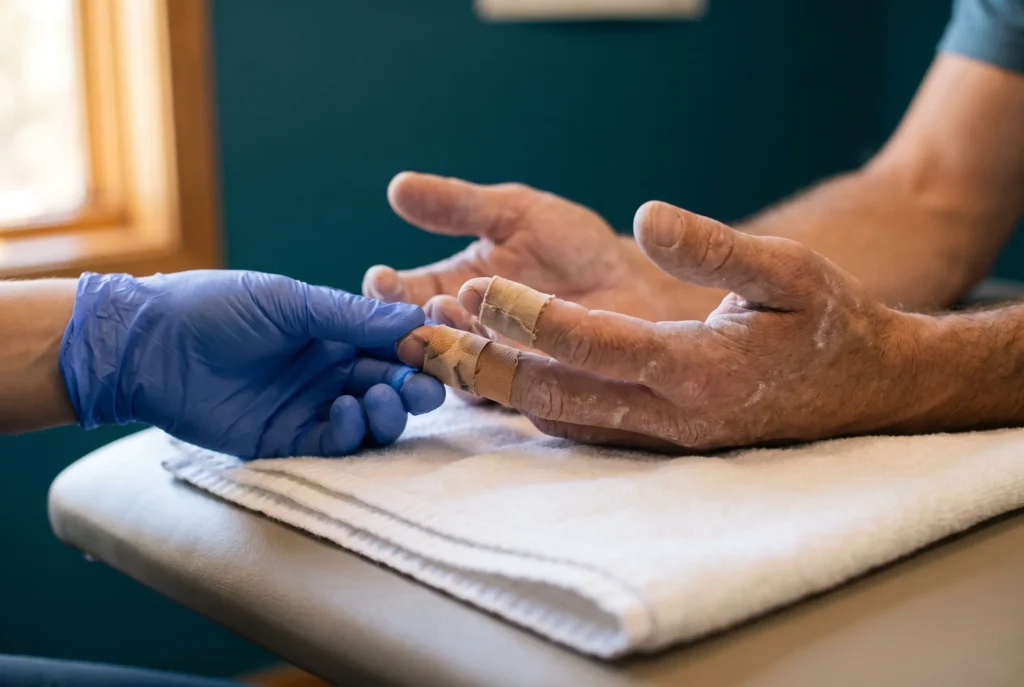
On a peninsula with no roads, a bad ankle does not just hurt — it strands you. Sprained ankle treatment in Railay starts with the question that decides everything else: is this a sprain, which we manage here, or a fracture, which means a boat to Krabi Town for an X-ray. There is a reliable way to tell without imaging, and it is worth knowing.
How they happen here
Almost never from a dramatic fall. The Railay ankle comes from stepping off a boulder at the base of a route, being lowered onto uneven ground, or the descent from the viewpoint trail where wet mud over rock offers no warning at all.
Add the beach path in the dark, the rocks between Railay West and Tonsai at low tide, and getting in and out of longtail boats onto sand that shelves unexpectedly.
The great majority are inversion injuries — the foot rolls inward and the ligaments on the outer side of the ankle take the strain. That is the standard sprain and it accounts for most of what we see.
Does it need an X-ray?
There is a well-validated clinical rule for this, and it is more reliable than how bad the swelling looks. Imaging is indicated if there is:
- Bone tenderness along the back edge of the inner or outer ankle bone
- Bone tenderness at the base of the fifth toe bone, on the outer edge of the foot
- Bone tenderness over the inner arch, at the navicular
- An inability to take four steps, even limping
Absent all four, a fracture is very unlikely. Present any one, and it needs an X-ray — which does not exist on the peninsula, so that means a crossing. See evacuation and hospital transfer.
Swelling and bruising, on their own, mean nothing diagnostically. A bad sprain swells dramatically and bruises down into the foot, and people arrive convinced it must be broken.
What to do in the first 48 hours
Compression and elevation, and take them seriously rather than nodding at them.
Elevate above heart level whenever you are sitting or lying — genuinely above, not resting on a low stool. An elastic bandage or proper strapping controls swelling, and less swelling means less pain and a faster recovery. Ice for fifteen to twenty minutes at a time, never directly against skin.
Prolonged complete rest is out of date. Move it gently within the limits of pain from early on, and put weight through it as soon as you can tolerate doing so. Ankles that are immobilised for a week stiffen and take substantially longer to recover.
What we do
Examine it properly, apply the rule above, and tell you plainly which category you are in. Then strapping or a support, pain relief and anti-inflammatories, and a realistic timeline.
The timeline is what people actually want. A mild sprain is roughly one to two weeks. A moderate one with significant swelling and bruising is three to six weeks before it feels reliable. A severe sprain can take longer than a simple fracture, which surprises everybody.
We also review it. An ankle that is no better at a week, or that gives way unexpectedly, needs looking at again rather than waiting out the trip.
Climbing on it, honestly
Not on the sharp end, not for a while. The problem is not pain tolerance — it is that a sprained ankle has lost proprioception, the unconscious sense of where the joint is and how to correct it, and that is exactly what stops you rolling it again on a bad landing.
That returns with rehabilitation rather than with time alone. Balance work on one leg, initially holding something, then not, then with eyes closed, restores it faster than resting does. Ten minutes a day makes a measurable difference.
Belaying is usually fine much sooner than climbing, and top-roping on good ground comes before anything with a committing start. Deep water soloing is the last thing to return to, because the landing is uncontrolled by definition. See climbing injury care.
The peninsula problem
Everything on Railay is a walk, in heat, often on sand or uneven rock. An injury that would be an inconvenience in a town with taxis is a genuine constraint here.
Crutches on sand are close to useless, and stairs up to hillside bungalows are worse. Think about whether your accommodation is workable before deciding to stay put for a week — some places here involve fifty steps and no handrail.
If you cannot get to us, ask for a doctor resort visit. And if you decide to leave the peninsula early because of the ankle, tell us and we will make sure you have the paperwork your insurer will want — see travel insurance claims.
The injuries that are not simple sprains
A few things masquerade as an ankle sprain and are treated differently.
A high ankle sprain, above the joint between the two leg bones, produces pain when the ankle is squeezed from side to side rather than pressed on the outer ligaments. It takes considerably longer to heal and needs a different approach.
An Achilles injury presents as pain behind the ankle rather than at the side, sometimes with a felt or heard snap, and inability to push off. That is urgent. And a fracture of the fifth toe bone, from the foot rolling under, produces tenderness on the outer edge of the foot rather than the ankle — which is exactly why that point is in the rule.
Frequently asked questions
How do I know if it is broken?
Bone tenderness on the ankle bones, the outer edge of the foot or the inner arch, or being unable to take four steps. Any of those needs an X-ray.
Do you have an X-ray here?
No. There is no imaging on the peninsula, so confirming a fracture means a crossing to Krabi Town, which we arrange.
How long until I can walk properly?
Mild sprains, one to two weeks. Moderate, three to six weeks before it feels reliable. Severe sprains can take longer than a simple fracture.
Should I rest it completely?
No. Gentle movement within pain limits from early on, and weight-bearing as soon as you can tolerate it. Immobilised ankles take longer.
When can I climb again?
Belaying and easy top-roping come back well before anything with a committing start. The limiting factor is proprioception, not pain.
Are crutches useful on Railay?
Barely, on sand. Consider whether your accommodation and its stairs are workable before deciding to stay put.
Should I keep icing it after the first few days?
Compression and elevation matter more beyond the first couple of days. Ice is mainly for early pain relief.
Who treats you here, and who is behind them
The clinic on Railay is run by experienced English-speaking nurses. Behind them sits Doctor Ao Nang Takecare Medical Clinic in Ao Nang, which Takecare Clinic Railay works together with as one service rather than two businesses: shared doctors, shared records, shared treatment plans. In practice that means a doctor is pulled in the moment your case needs one — to review it, to prescribe, or to come across to the peninsula in person. If you later cross to the mainland, whoever sees you is already holding your notes and you are not starting the story again. It also means the second opinion that would otherwise cost you a boat and half a day costs a phone call.
Getting seen
Opening hours are 8am–10pm daily. Outside them we are still reachable 24 hours by phone, WhatsApp and Line, so when something happens at eleven at night the right move is to message us, not to lie awake deciding whether it can wait. No appointment is needed at any point — walk in, or reach us on +66 81 718 9080, WhatsApp or Line. If you would rather not move, ask for a doctor resort visit and we will come to you. And if this turns out to be something the peninsula cannot handle, that call is also how the boat and the hospital transfer start moving.