Travel Insurance Claims in Railay
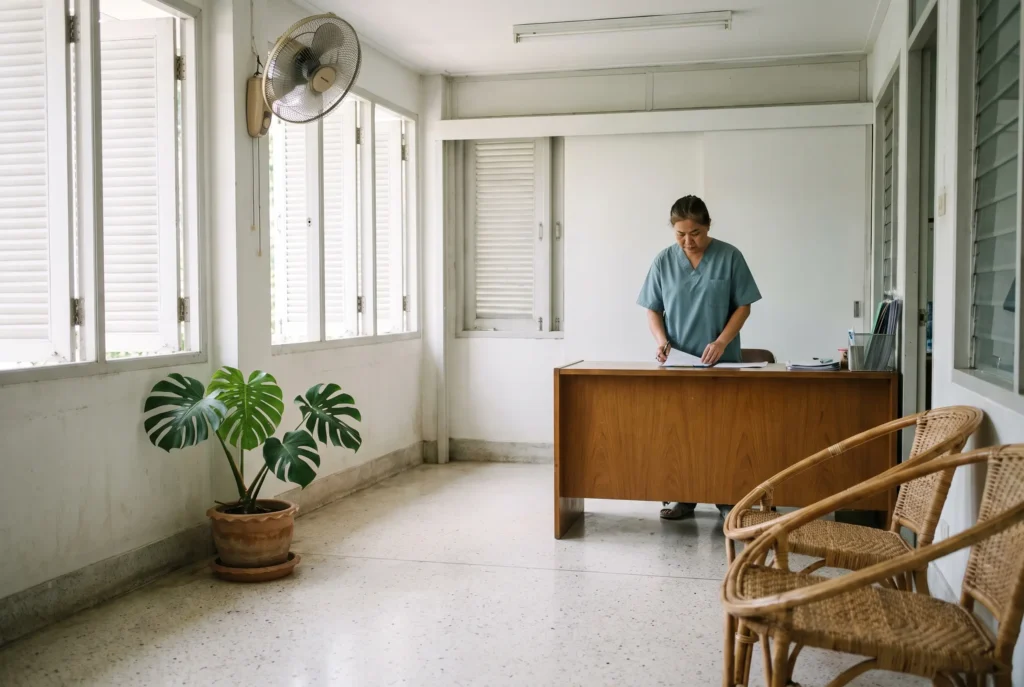
Insurers reject claims for paperwork reasons far more often than for medical ones. The treatment was covered, the receipt was not itemised; the illness was covered, the activity was excluded. Travel insurance claims in Railay go considerably better when the documents are produced correctly on the day, which is why we do that as standard rather than on request.
What you leave with
Every patient gets an itemised receipt and an English medical report. Those two documents cover the requirements of nearly every travel policy.
The receipt lists each item separately — consultation, each medication, each test, each procedure — with prices, rather than a single total. A lump sum is the commonest reason a claim gets returned for more information, and more information from another country a fortnight later is much harder to obtain.
The report states the date, the presenting complaint, the examination findings, the diagnosis, the treatment given, and any follow-up advised. It is written in English and signed, and it is what an insurer’s medical assessor actually reads.
Say the word insurance at the start
This is the single most useful thing you can do, and it costs nothing.
Mentioning it at the beginning changes what gets documented while you are still in the room — how the mechanism of injury is described, whether specific findings are recorded explicitly, whether a follow-up recommendation is written down. Reconstructing that after you have flown home is considerably harder and sometimes impossible.
Many policies also require notification while treatment is happening, particularly for anything expensive. A quick call from the clinic satisfies that; a claim submitted a month later without it may not.
The climbing exclusion, which catches people every season
A great many standard travel policies exclude rock climbing outright. Others cover it only up to a certain grade, only with a rope, only with a qualified instructor, or exclude bouldering and deep water soloing specifically.
Railay is a climbing destination, so this is not a marginal concern here — it is the single commonest reason a Railay claim fails. And people rarely check, because the marketing page says adventure sports and the policy wording says something narrower.
Read the actual policy document before you travel, not the summary. If it is ambiguous, email the insurer and keep the reply. If you are not covered, a specialist climbing policy costs far less than one evacuation — see climbing injury care.
Other exclusions worth knowing about
Alcohol is a large one. Most policies exclude injuries sustained while intoxicated, and the definition is often looser than you would like. If alcohol was genuinely involved, we document what we observed accurately — we will not write something untrue, and a false record helps nobody if it is later checked.
Motorbike injuries are excluded unless you hold the correct licence and were wearing a helmet, which strands a remarkable number of travellers. Pre-existing conditions are excluded unless declared. Pregnancy beyond a certain stage is usually excluded.
And most policies exclude treatment you could reasonably have delayed until returning home, which is why the report noting that treatment was necessary at the time matters.
How reimbursement actually works here
Most travellers pay at the clinic and claim afterwards. That is normal and generally the fastest route, because our costs are low enough that the amount involved is rarely a hardship.
Direct billing to an insurer is unusual for a clinic of this size and on a peninsula reached by boat. For a hospital admission in Krabi Town it is common, and it is worth calling your insurer to arrange before you arrive at the hospital rather than after.
Keep everything: the itemised receipt, the medical report, any prescription, and the boat and transport receipts if you were evacuated. Photograph them the same day — paper does not survive a fortnight in a damp bag on a beach.
Evacuations, where the money actually is
A consultation here is inexpensive enough that some people do not bother claiming. An evacuation and hospital transfer is a different order of magnitude, and that is what insurance exists for.
Boat charter, ambulance, hospital admission and possibly a repatriation flight add up quickly. Every policy that covers emergency transfer wants to be told while it is happening, and many require pre-authorisation of the receiving hospital.
Call them from the clinic while we prepare you. We can provide the clinical detail the insurer will ask for over the phone, which is a conversation that is much easier with a nurse standing next to you than alone on a boat.
If a claim is refused
Refusals are frequently reversed on appeal, and the usual reason for the initial refusal is missing detail rather than a genuine exclusion.
Read the stated reason carefully. If it is a documentation gap, contact us — we hold your records and can usually supply a fuller report, a clearer breakdown, or a clarification of the clinical reasoning. That can be done long after you have gone home.
If the refusal cites an exclusion that does not apply to what actually happened, say so in writing with the report attached. A description that says a fall while walking is materially different from a description that says a climbing accident, and precision in the original report is what makes that argument possible.
Frequently asked questions
What documents will I get?
An itemised receipt and a signed English medical report, as standard for every patient.
Do you bill my insurer directly?
Usually not — most travellers pay and claim afterwards. Direct billing is more common for hospital admissions in Krabi Town.
Is rock climbing covered by travel insurance?
Often not. Many standard policies exclude it outright or restrict it heavily. Check the policy wording before you travel.
What if I lose the paperwork?
Contact us. We hold your records and can reissue. Photograph everything on the day as well — paper does not last long in this climate.
Should I tell you about insurance before or after treatment?
Before, always. It changes what gets documented while you are still in the room.
Will you write the report to match my policy?
We write what actually happened. An accurate report is what survives scrutiny; an inaccurate one collapses the moment anyone checks.
My claim was refused. Can you help?
Often, yes. Most initial refusals are about missing detail, and we can supply a fuller report or clarification even months later.
Who treats you here, and who is behind them
The clinic on Railay is run by experienced English-speaking nurses. Behind them sits Doctor Ao Nang Takecare Medical Clinic in Ao Nang, which Takecare Clinic Railay works together with as one service rather than two businesses: shared doctors, shared records, shared treatment plans. In practice that means a doctor is pulled in the moment your case needs one — to review it, to prescribe, or to come across to the peninsula in person. If you later cross to the mainland, whoever sees you is already holding your notes and you are not starting the story again. It also means the second opinion that would otherwise cost you a boat and half a day costs a phone call.
Getting seen
Opening hours are 8am–10pm daily. Outside them we are still reachable 24 hours by phone, WhatsApp and Line, so when something happens at eleven at night the right move is to message us, not to lie awake deciding whether it can wait. No appointment is needed at any point — walk in, or reach us on +66 81 718 9080, WhatsApp or Line. If you would rather not move, ask for a doctor resort visit and we will come to you. And if this turns out to be something the peninsula cannot handle, that call is also how the boat and the hospital transfer start moving.