Climbing finger injury treatment in Railay
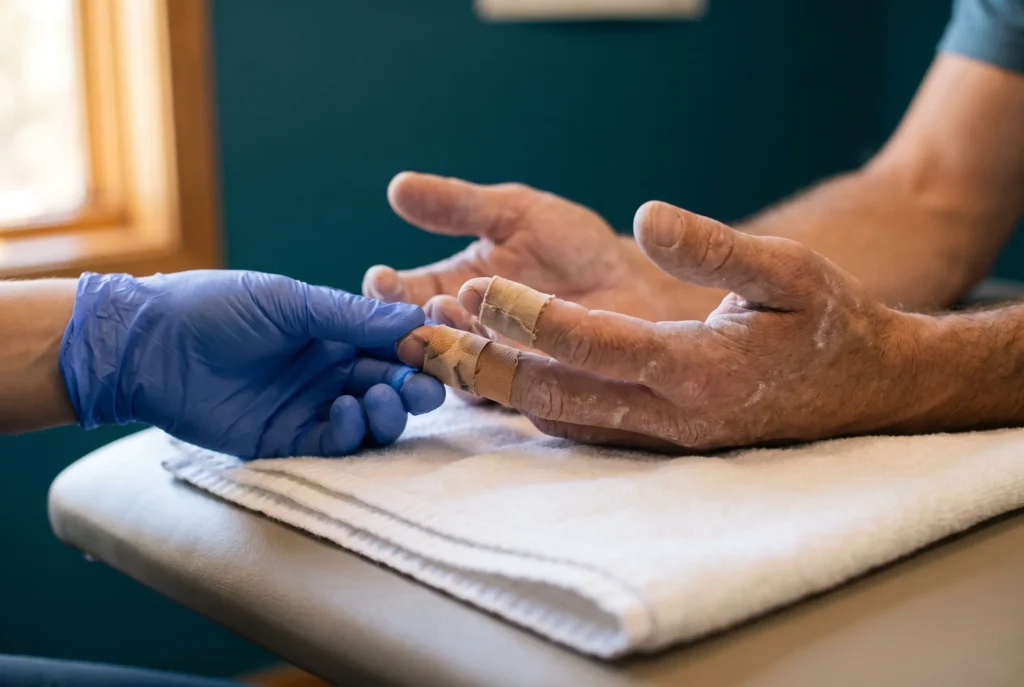
A sharp pain at the base of a finger on a crimp, sometimes with an audible pop, and now it hurts to close the hand. Finger injuries are the most common climbing complaint on this peninsula, and also the ones most often made permanent by carrying on. Climbing finger injury treatment in Railay starts with working out which structure actually failed.
Pulley injuries, the classic
The flexor tendons in each finger are held against the bone by bands of tissue called pulleys. Overload one — usually the A2 pulley at the base of the finger — and it strains or ruptures.
The story is consistent: a crimp, a foot slipping, sudden load on a half-crimped finger, a sharp pain and sometimes a pop that the belayer hears too. Then swelling and tenderness at the base of the finger, and pain on crimping that eases when the hand is open.
The grade decides the timeline. A mild strain settles with a week or two of rest and careful taping. A partial tear needs several weeks. A full rupture — where the tendon visibly bowstrings away from the bone as you resist a bend — is a different problem and needs a surgical opinion on the mainland.
Tendon overuse, which is not an accident
If nothing happened suddenly and the finger has simply worsened over several days, this is volume rather than injury.
The pattern is the trip itself: arriving with two weeks, climbing five days straight on limestone sharper and steeper than anything at home, and finding by day four that the fingers ache in the morning and hurt on the first hard move.
That responds to rest and to nothing else. It also returns within a day of resuming if the rest was inadequate, which is how people spend a fortnight repeatedly rediscovering the same injury and concluding that Railay broke their hands.
Collateral ligaments and joints
Pain and swelling at the side of a finger joint rather than at its base points to a collateral ligament, usually from a finger twisted in a pocket or a mono.
Swelling over the joint itself, with stiffness and a thickened feel, is often synovitis — irritation of the joint lining from repeated loading. Common in climbers and slow to settle.
Both are managed here. What needs a mainland opinion is a finger that will not straighten, any obvious deformity, numbness, or a joint that feels unstable when stressed sideways — see evacuation and hospital transfer.
Split tips, which Railay excels at
Tonsai limestone is sharp, and a fortnight of it opens hands up. Splits at the fingertip and across the pads are not injuries in the ligament sense, but they end trips just as effectively.
Keep them clean and dry overnight, and do not superglue over a dirty split — that seals bacteria inside and produces an infected fingertip, which is genuinely painful and takes far longer than the split would have.
Clean first, dry properly, then close a clean split if you want to. File thick calloused edges down rather than letting them build, because thick skin tears deeper than supple skin. Come in if a split becomes red, swollen and throbbing — see wound dressing.
What we can and cannot do here
We assess it properly, tell you which structure is involved and how badly, and give you a real timeline rather than a comfortable one. Then taping or splinting where it helps, anti-inflammatories, and advice on what you can still climb.
What we cannot do is imaging. There is no ultrasound or MRI on the peninsula, so a suspected full pulley rupture or a tendon injury needing visualisation means a crossing to Krabi Town.
We can also write the report your insurer will want, which for climbing injuries needs the mechanism described accurately — read travel insurance claims before you need it, because a great many policies exclude climbing outright.
Taping, and what it actually does
Tape does not prevent pulley injuries. That deserves stating plainly, because many climbers believe it does and tape prophylactically instead of managing load.
What tape does is support a finger that is already injured, and reduce load on a healing pulley enough to allow easier climbing during recovery. H-taping and circumferential taping both help in that context.
On healthy fingers it provides a little proprioceptive feedback and a great deal of false confidence. What actually prevents finger injuries is warming up properly, open-handing where possible instead of full crimping, and taking rest days before you need them.
Recovering without losing the trip
Complete rest is rarely the answer beyond the first few days. Pain-free movement, gentle loading progressed slowly, and returning to easier climbing before hard climbing beats sitting still for two weeks and restarting where you left off.
Practically: switch to juggy routes and open-handed climbing, avoid pockets and crimps entirely, and stop the moment it hurts rather than at the end of the route. Railay has a great deal of easier climbing on big holds, which makes this more workable here than at most destinations.
And the rule that saves trips: if a finger hurt yesterday and hurts more today, that is information. Coming in on day two costs a consultation. Coming in on day six costs the rest of the season. See climbing injury care.
Frequently asked questions
Did I rupture my pulley or just strain it?
A strain is tender and painful to crimp. A full rupture usually involves a loud pop and visible bowstringing of the tendon when you resist a bend — that needs a surgical opinion.
Can I keep climbing on it?
Not while crimping hurts. Continuing through pulley pain is the most reliable way to turn two weeks off into several months.
Does taping prevent finger injuries?
No. It supports an already injured finger. On healthy fingers it mostly provides false confidence.
Do you have an ultrasound or MRI?
No. There is no imaging on the peninsula. Where a tendon injury needs visualising, that means a crossing to Krabi Town.
How long until I can crimp again?
A mild strain, one to two weeks. A partial tear, several weeks. A full rupture is a different conversation entirely.
Should I superglue a split tip?
Only after cleaning and drying it. Gluing over a dirty split seals bacteria inside and produces an infected fingertip.
My fingers ache every morning. Is that an injury?
Usually volume rather than damage — too much hard climbing too early in a trip. It needs genuine rest days, not tape.
Who treats you here, and who is behind them
The clinic on Railay is run by experienced English-speaking nurses. Behind them sits Doctor Ao Nang Takecare Medical Clinic in Ao Nang, which Takecare Clinic Railay works together with as one service rather than two businesses: shared doctors, shared records, shared treatment plans. In practice that means a doctor is pulled in the moment your case needs one — to review it, to prescribe, or to come across to the peninsula in person. If you later cross to the mainland, whoever sees you is already holding your notes and you are not starting the story again. It also means the second opinion that would otherwise cost you a boat and half a day costs a phone call.
Getting seen
Opening hours are 8am–10pm daily. Outside them we are still reachable 24 hours by phone, WhatsApp and Line, so when something happens at eleven at night the right move is to message us, not to lie awake deciding whether it can wait. No appointment is needed at any point — walk in, or reach us on +66 81 718 9080, WhatsApp or Line. If you would rather not move, ask for a doctor resort visit and we will come to you. And if this turns out to be something the peninsula cannot handle, that call is also how the boat and the hospital transfer start moving.