Sea urchin spine treatment in Railay
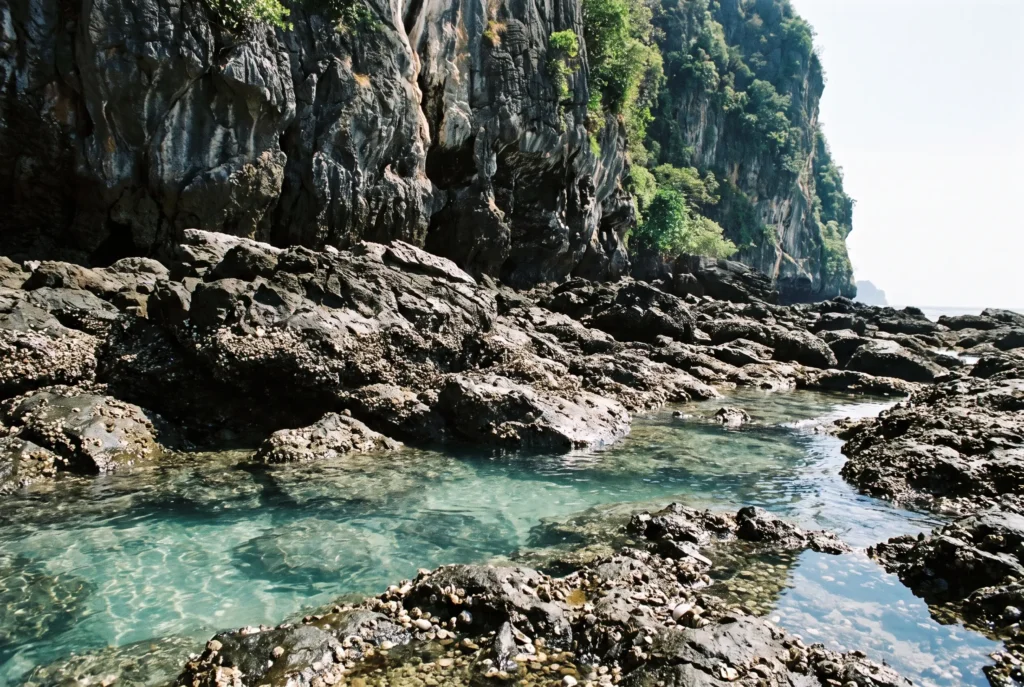
You step off a rock in shallow water, feel a sharp jab, and lift your foot to find several black spines broken off in it. Sea urchins are abundant along this shoreline, particularly around the rocks at Phra Nang and Tonsai. Sea urchin spine treatment in Railay is largely about knowing which spines need removing and which are better left alone.
What happens when you stand on one
Immediate sharp pain, then a deep ache that persists for hours. The spines are brittle and hollow, so they break off rather than pull out, and the fragments left behind are often dark under the skin and easy to see.
Some species carry a mild venom that causes local pain and swelling beyond the puncture itself. Serious systemic reactions are rare here, but numbness, muscle weakness, breathing difficulty or chest pain after a sting means calling 1669 and calling us — see urgent medical care.
The dark staining left behind is often dye from the spine rather than the spine itself, and it fades on its own over days. That confuses people into digging for something that is no longer there.
Which spines need removing
Not all of them, and this is the part that goes wrong at resorts with a pair of tweezers and good intentions.
Remove: spines in a joint or over a tendon, spines in the sole of the foot where you will be walking on them, spines that are superficial and come out easily, and any that are causing spreading pain or showing signs of infection.
Leave: small, deep, superficial fragments that are not near a joint and not causing symptoms. The body breaks these down and absorbs them over weeks, and the damage done digging for a fragment routinely exceeds the damage the fragment would have caused.
First aid on the beach
Get out of the water and sit down before trying anything, because standing on it drives fragments deeper.
Soak the area in water as hot as you can tolerate without scalding, for thirty to ninety minutes. As with jellyfish, the venom proteins break down with heat, and the pain relief is substantial. This is by far the most useful thing available before you reach a clinic.
Remove any spines that protrude clearly and come out without resistance, using tweezers rather than fingers. Then stop. Do not dig, do not squeeze, do not attack it with a needle, and ignore the vinegar-and-hammer method that circulates on this coast — tapping the area to shatter spines does more harm than good.
What we do at the clinic
Local anaesthetic first, which turns an unpleasant exploration into a comfortable one and lets the job be done properly rather than quickly.
Then removal under good light with fine instruments, taking out what should come out and leaving what should stay. Where a spine sits deep near a joint, we will say so honestly — that occasionally needs imaging and a surgical opinion in Krabi Town, which is a boat ride.
Alongside that: cleaning, tetanus cover if your last booster is beyond ten years or unknown, and antibiotics where the puncture is deep or already looking infected. Sea water punctures are exactly the wounds that go bad on this coast.
Infection, which is the real risk
The venom hurts; the bacteria are what cause problems. A puncture wound seals over the top while carrying sea water organisms into deep tissue, which is close to ideal conditions for infection.
Come back for increasing rather than decreasing pain after day two, redness spreading outward, swelling that worsens, discharge, difficulty moving a nearby joint, or fever. Spreading redness is cellulitis and needs antibiotics the same day.
A spine that sits near a joint and later causes swelling and stiffness needs assessing rather than waiting — infection inside a joint is a different order of problem and does not resolve with patience.
The weeks afterwards
Retained fragments usually dissolve over two to six weeks. Some work their way to the surface and can be lifted out easily once they arrive.
Occasionally a small firm lump forms around a retained fragment. That is the body walling it off, it is not dangerous, and it usually settles. If it becomes painful or grows, it needs looking at — see minor surgery.
Keep the area clean and covered while the punctures are open, and stay out of the sea until they have closed. That is a few days rather than weeks, and it prevents the great majority of infections.
Avoiding them, which is genuinely easy
Reef shoes. That is the whole answer, and it is why locals wear them and visitors do not.
Urchins sit in crevices and on rock rather than on open sand, so the risk is highest getting in and out of the water over rocks, at low tide, and around the boulders at either end of the beaches. Wading out to a longtail at low tide is the classic scenario.
Shuffle rather than step where you cannot see the bottom. Do not put hands into crevices while snorkelling. And be particularly careful at dusk, when urchins become more active and visibility drops at exactly the same time.
Cheap reef shoes from any beach shop here are entirely adequate for this — they do not need to be good, they need to be on your feet. A pair costs less than the consultation to have spines taken out of one foot.
Frequently asked questions
Do all the spines need to come out?
No. Spines in joints, in the sole of the foot, or causing symptoms should come out. Small deep fragments are usually better left to be absorbed.
Does hot water help?
Yes, considerably. Soak as hot as you can tolerate without scalding for thirty to ninety minutes — it breaks down the venom.
Should I use vinegar?
It is often suggested here and does little for urchin spines. Hot water is the effective treatment.
The skin is stained black. Is a spine still in there?
Often not. Dye from the spine stains the skin and fades over days, which is why people dig for fragments that are no longer present.
How do I know if it is infected?
Increasing pain after day two, spreading redness, swelling, discharge, fever, or difficulty moving a nearby joint. Come in the same day.
How long do retained fragments take to disappear?
Usually two to six weeks. Some surface and can be lifted out easily.
Can I swim afterwards?
Wait until the punctures have closed, which is usually a few days. Sea water in open punctures is how these become infected.
Who treats you here, and who is behind them
The clinic on Railay is run by experienced English-speaking nurses. Behind them sits Doctor Ao Nang Takecare Medical Clinic in Ao Nang, which Takecare Clinic Railay works together with as one service rather than two businesses: shared doctors, shared records, shared treatment plans. In practice that means a doctor is pulled in the moment your case needs one — to review it, to prescribe, or to come across to the peninsula in person. If you later cross to the mainland, whoever sees you is already holding your notes and you are not starting the story again. It also means the second opinion that would otherwise cost you a boat and half a day costs a phone call.
Getting seen
Opening hours are 8am–10pm daily. Outside them we are still reachable 24 hours by phone, WhatsApp and Line, so when something happens at eleven at night the right move is to message us, not to lie awake deciding whether it can wait. No appointment is needed at any point — walk in, or reach us on +66 81 718 9080, WhatsApp or Line. If you would rather not move, ask for a doctor resort visit and we will come to you. And if this turns out to be something the peninsula cannot handle, that call is also how the boat and the hospital transfer start moving.