Ear infection treatment in Railay
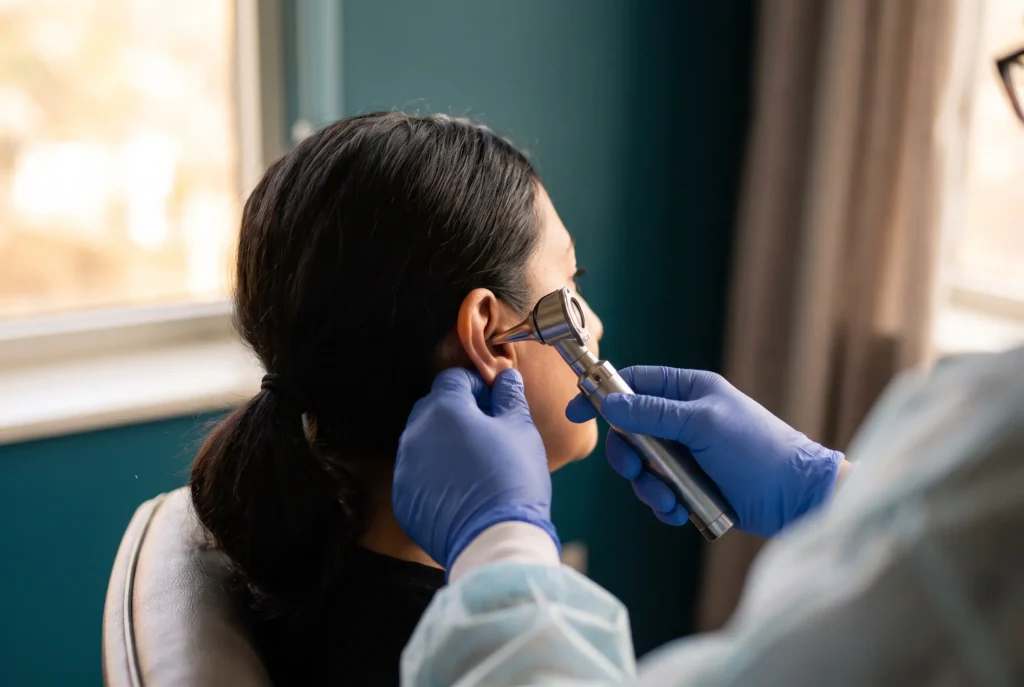
Three days of swimming and snorkelling, and now one ear throbs. It hurts to lie on that side, tugging the earlobe makes you wince, and it has kept you awake since two in the morning. This is swimmer’s ear, and on a peninsula where everyone is in the sea daily it is among the most common things we treat. Ear infection treatment in Railay usually means antibiotic drops, with the pain settling within a couple of days.
Outer ear or middle ear
The two are treated completely differently, which is why an examination beats guessing at the pharmacy.
Outer ear infection — swimmer’s ear — affects the canal itself. Water softens the skin lining it and lets bacteria in. The canal looks red and swollen, and the giveaway is that pulling the earlobe or pressing the small flap in front of the ear hurts sharply.
Middle ear infection sits behind the eardrum, usually follows a cold, is far commoner in children, and does not hurt when you tug the ear. Drops do very little for it, because medication cannot reach behind an intact eardrum.
Why Railay produces so many
Days in warm sea water, then a shower, then a humid bungalow where the canal never fully dries. Warm and damp is close to ideal for the bacteria involved.
Add the specific behaviours: earplugs for swimming, which trap moisture; cotton buds afterwards, which strip the protective wax and scratch the canal; and diving, which forces water in under pressure.
Wax is protective here rather than dirty. It is slightly acidic and mildly antibacterial, and people who scrupulously remove it get more infections than people who leave it alone — see ear wax removal for when it genuinely does need clearing.
How it is treated
Antibiotic ear drops, usually with a steroid to reduce the swelling, for about a week. Pain relief matters as well, because ear pain is disproportionate to the size of the problem and disrupts sleep badly.
Where the canal is too swollen for drops to get in, a small wick can be placed to carry medication along it. That sounds worse than it is and makes a large difference.
Oral antibiotics are reserved for infection spreading beyond the canal, or for people with diabetes or a weakened immune system, where outer ear infections can become serious.
Get the drops in properly: lie on your side, put them in, and stay there for several minutes. Drops that run straight back out treat the pillow.
Keeping out of the water
This is the part nobody wants to hear on a beach holiday, and it is the part that decides how long this lasts.
Stay out of the sea for the duration of treatment — usually seven to ten days. Swimming through it keeps reintroducing water and bacteria into a canal that is trying to heal, and turns a one-week problem into a three-week one.
Keep the ear dry in the shower too. A smear of petroleum jelly on a cotton wool ball at the entrance of the canal works well. Do not push anything further in than that.
When it is more than a simple infection
Come back or come in urgently for any of these:
- Swelling or redness spreading onto the skin behind or below the ear
- Fever with the ear pain
- Facial weakness on the same side
- Severe pain not controlled by ordinary painkillers
- Dizziness or spinning
- Hearing loss that is getting worse rather than better
Redness and tenderness over the bone behind the ear can indicate mastoiditis, which needs intravenous antibiotics in hospital. It is uncommon, and it is the reason ear pain with fever is not something to sleep on.
Children, ears and flights
Middle ear infections are far commoner in children, and a child pulling at one ear with a fever after a cold is the classic presentation.
Many resolve without antibiotics, and the usual approach is good pain relief with review, rather than antibiotics immediately. Where a child is very unwell, very young, or not improving, that changes.
Flying with an ear infection is genuinely painful for a child on descent. If you are flying within a couple of days, come in beforehand rather than discovering the problem at ten thousand feet — and see urgent medical care if a child is distressed and febrile out of hours.
Preventing the next one
Tilt your head each side after swimming and let water run out, then dry the outer ear. Do not use cotton buds at all.
If you swim daily and are prone to this, drying drops help — either a commercial preparation or equal parts white vinegar and rubbing alcohol, a few drops after swimming. The vinegar restores the acidity that discourages bacteria. Do not use it if there is any chance of a perforated eardrum or if you have grommets.
Consider whether your earplugs are helping or hurting. For some people they prevent water entry; for others they trap what is already there and make things worse.
One thing specific to this coast: the water quality around the beaches varies through the season, and it is noticeably worse after heavy rain, when run-off carries everything from the hillside into the bay. Swimmer’s ear cases rise reliably in the days following a big storm. If you have had one infection already this trip, that is the week to snorkel somewhere else or take a day off the water entirely.
Frequently asked questions
How do I know if it is swimmer’s ear?
Pulling the earlobe or pressing the flap in front of the ear hurts sharply. That points to the outer canal rather than the middle ear.
How long before it feels better?
Usually noticeably better within two to three days of starting drops, with a full course of about a week.
Can I swim during treatment?
No. Staying out of the water for seven to ten days is what makes the difference between a short problem and a long one.
Do I need oral antibiotics?
Usually not. Drops treat the canal directly. Tablets are for infection spreading beyond it, or for people with diabetes or reduced immunity.
Can I fly with an ear infection?
It will hurt on descent, particularly for children. Come in before you fly rather than after take-off.
What can I do to prevent it?
Dry your ears after swimming, stop using cotton buds, and consider drying drops if you are in the water daily.
When is ear pain an emergency?
Fever with the pain, swelling behind the ear, facial weakness, or severe dizziness. Those need seeing without delay.
Who treats you here, and who is behind them
The clinic on Railay is run by experienced English-speaking nurses. Behind them sits Doctor Ao Nang Takecare Medical Clinic in Ao Nang, which Takecare Clinic Railay works together with as one service rather than two businesses: shared doctors, shared records, shared treatment plans. In practice that means a doctor is pulled in the moment your case needs one — to review it, to prescribe, or to come across to the peninsula in person. If you later cross to the mainland, whoever sees you is already holding your notes and you are not starting the story again. It also means the second opinion that would otherwise cost you a boat and half a day costs a phone call.
Getting seen
Opening hours are 8am–10pm daily. Outside them we are still reachable 24 hours by phone, WhatsApp and Line, so when something happens at eleven at night the right move is to message us, not to lie awake deciding whether it can wait. No appointment is needed at any point — walk in, or reach us on +66 81 718 9080, WhatsApp or Line. If you would rather not move, ask for a doctor resort visit and we will come to you. And if this turns out to be something the peninsula cannot handle, that call is also how the boat and the hospital transfer start moving.