Medical Certificate in Railay
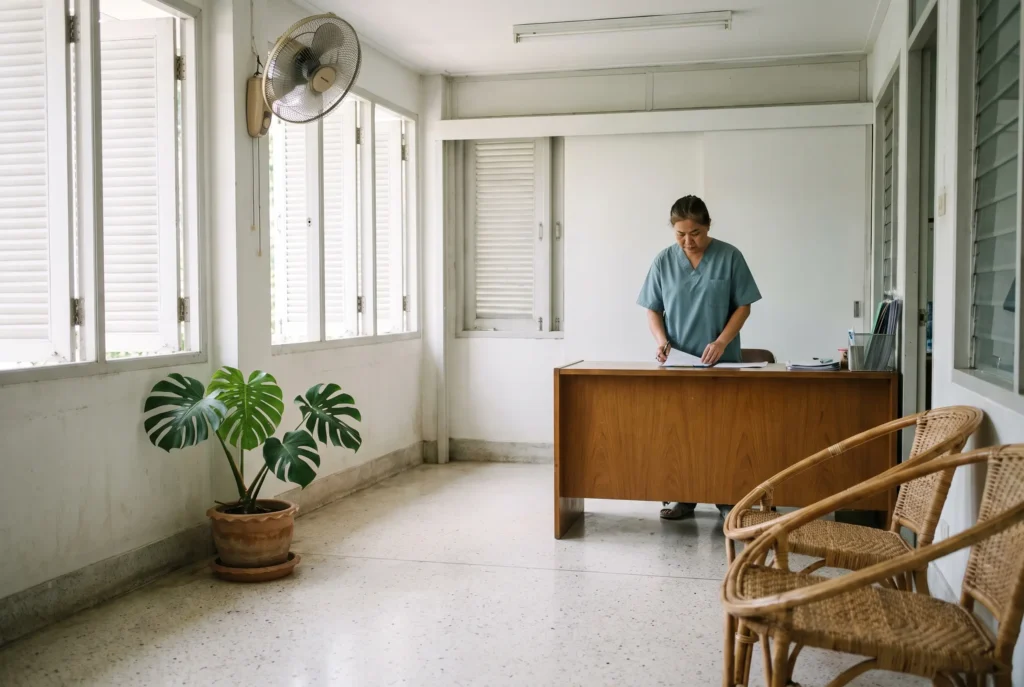
Certificates are one of the few things people need from a clinic while feeling perfectly well. Work permits, diving courses, visa extensions, employers wanting proof of sick leave, airlines wanting confirmation you are fit to board. A medical certificate in Railay is usually issued the same visit, and the thing that decides whether it is accepted is getting the right one in the first place.
What we issue
The common ones, in rough order of how often they are asked for:
- Fit-to-dive certificates for PADI and SSI courses
- Work permit medical certificates for Thai employment
- Visa extension certificates
- Sick leave certificates for employers
- Fit-to-fly certificates for airlines
- General fitness certificates for gyms, courses and insurers
Each has different content requirements, and several have a specific form that must be used. Tell us which you need at the start of the visit rather than at the end — the examination differs, and doing the wrong one means doing it twice.
Fit to dive, which is the one that catches people out
Every dive school around Ao Nang and Ton Sai will ask you to complete a medical questionnaire. Answer yes to anything on it and you need a doctor’s sign-off before you can get in the water.
The questions that most often trigger it are asthma, any history of collapsed lung, ear surgery, epilepsy, diabetes, heart conditions, recent surgery, and pregnancy. Asthma is the frequent one, and a yes there does not automatically mean no — well-controlled asthma is often cleared, and it is assessed rather than refused on the label.
The genuine blocker is a blocked nose. If you cannot equalise, you cannot dive safely at any grade of certificate, and a sinus infection or ear infection means postponing rather than pushing through. Forcing a descent with a blocked sinus risks barotrauma and bleeding.
Work permits and visa extensions
Thai work permit applications require a medical certificate confirming freedom from a defined list of conditions — tertiary syphilis, tuberculosis, leprosy, elephantiasis, and drug addiction.
The requirement is standard and the examination is brief, but the form matters. Requirements vary between provinces and occasionally between offices within a province, so bring whatever paperwork your employer or agent gave you rather than assuming a generic certificate will pass.
Where a specific government form is needed, tell us and bring it. We will complete the form you have been given rather than producing our own and hoping.
Fit to fly, and when an airline will actually ask
Airlines ask in a narrower set of circumstances than people expect: recent surgery, recent fracture in a cast, pregnancy beyond about twenty-eight weeks, a recent significant illness, or any visible injury that makes cabin crew uncertain.
A leg in a full cast is the one that regularly strands travellers. Many airlines require the cast to be split, or require a certain interval after the injury, and finding that out at check-in is a bad way to discover it.
If you have had anything significant happen on this trip and are flying soon, ask us before you get to the airport. The certificate is quick; renegotiating a flight is not.
Sick leave, and being straight about what we will write
We issue sick leave certificates for genuine illness, and they state the dates and a general description rather than a detailed diagnosis, which is what most employers actually require.
What we will not do is backdate a certificate for days we did not see you, or certify an illness that was not assessed. That is not primness — a backdated certificate is worthless the moment an employer questions it, and it puts the clinic’s signature behind something nobody verified.
If you were genuinely unwell earlier in the week and did not come in, say so. We can often write something accurate covering the consultation and the reported history, which is honest and usually sufficient.
What the examination involves
For most certificates: blood pressure, pulse, temperature, height and weight, a look at heart and lungs, and a review of your medical history and current medication.
Some require blood tests, and a few require a chest X-ray — which does not exist on the peninsula and means a crossing to Krabi Town. We will tell you that at the start rather than halfway through, so you can plan the day around it.
Bring your passport, since certificates carry your passport name and number, and bring any form you have been given. If you take regular medication, bring the box.
Timing, cost and how long it stays valid
Most certificates are issued the same visit, in English, signed and stamped. Where blood tests are needed, allow a few hours to a day.
Cost depends on the type and whether tests are involved, and it is quoted before anything is done. Certificates are inexpensive compared with the trip they are protecting.
Validity varies: many Thai authorities accept a certificate issued within the last thirty days, dive schools generally want one within twelve months, and airlines usually want one issued within a few days of the flight. Getting a certificate a month early is a common and avoidable waste — check the window before you come in.
Frequently asked questions
Can I get a certificate the same day?
Usually yes, issued in English and signed. If blood tests are needed, allow a few hours to a day.
I answered yes on the dive medical form. Can I still dive?
Often yes. Conditions like well-controlled asthma are frequently cleared. It is assessed properly rather than refused on the label.
Do you have a chest X-ray?
No. Where a certificate requires one, that means a trip to Krabi Town, and we will tell you at the start rather than midway.
How much does a medical certificate cost?
It depends on the type and whether tests are needed. You are quoted before anything begins.
Will you backdate a sick note?
No. We certify what was assessed. If you were ill earlier and did not come in, tell us and we can usually write something accurate.
How long is it valid?
It varies — often thirty days for Thai authorities, twelve months for dive schools, and only a few days for airlines. Check before coming in.
What should I bring?
Your passport, any form you were given by your employer, agent or dive school, and the boxes of any medication you take.
Who treats you here, and who is behind them
The clinic on Railay is run by experienced English-speaking nurses. Behind them sits Doctor Ao Nang Takecare Medical Clinic in Ao Nang, which Takecare Clinic Railay works together with as one service rather than two businesses: shared doctors, shared records, shared treatment plans. In practice that means a doctor is pulled in the moment your case needs one — to review it, to prescribe, or to come across to the peninsula in person. If you later cross to the mainland, whoever sees you is already holding your notes and you are not starting the story again. It also means the second opinion that would otherwise cost you a boat and half a day costs a phone call.
Getting seen
Opening hours are 8am–10pm daily. Outside them we are still reachable 24 hours by phone, WhatsApp and Line, so when something happens at eleven at night the right move is to message us, not to lie awake deciding whether it can wait. No appointment is needed at any point — walk in, or reach us on +66 81 718 9080, WhatsApp or Line. If you would rather not move, ask for a doctor resort visit and we will come to you. And if this turns out to be something the peninsula cannot handle, that call is also how the boat and the hospital transfer start moving.