Climbing Injury Care in Railay
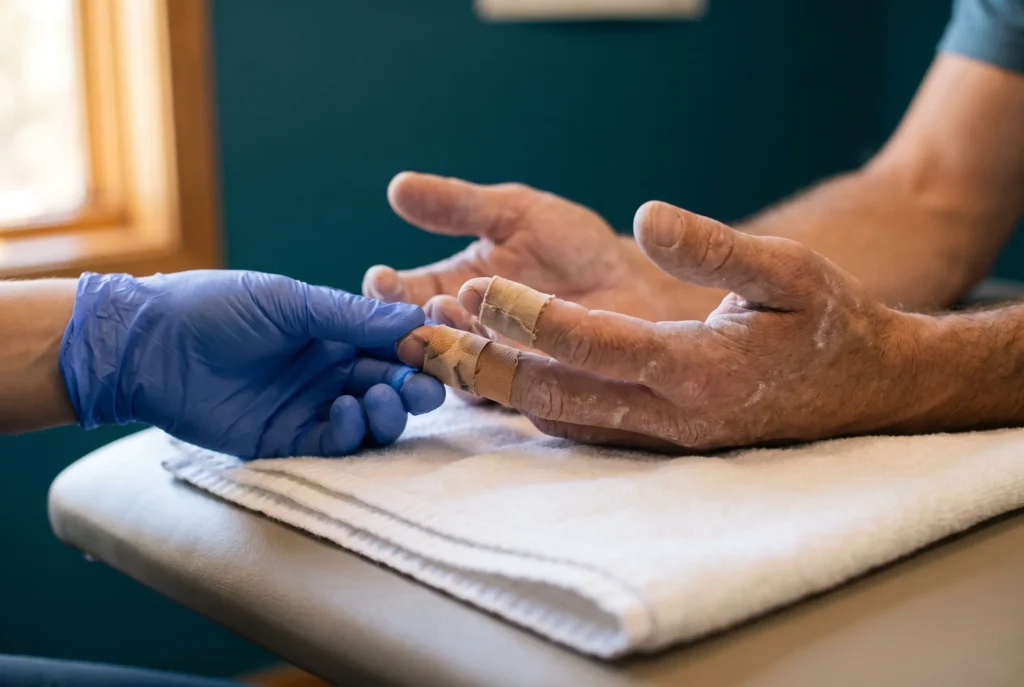
Railay is one of the best-known limestone sport-climbing destinations in the world, and the injuries arrive in a predictable shape: fingers, ankles, shoulders and skin. Climbing injury care in Railay is most of what we do in high season, and the useful part is not sympathy — it is telling you honestly whether this is three days off or the end of your trip.
What comes through the door most
Finger injuries lead comfortably. Pulley strains from a crimp that went wrong, tendon pain from too much volume too early in a trip, and split tips from sharp Tonsai limestone.
Then ankles. Almost all of them are ground falls or bad landings from the first bolt, not big whippers — the classic Railay injury is someone stepping off a boulder or being lowered onto uneven ground.
After that: shoulders from a hard catch or a dynamic move, rope burns from a fast lower or a slip through the belay hand, and skin torn open on rock that is far sharper than it looks. Deep water soloing at Tonsai adds its own category — flat landings from height, which bruise ribs and knock the wind out in a way people underestimate.
Finger injuries, and the question everyone asks
The question is always the same: can I climb tomorrow. The answer depends on what actually failed.
A pulley strain usually announces itself with a sharp pain at the base of the finger, sometimes an audible pop, and pain when crimping that eases when you open the hand. A mild one settles with a week or two of rest and careful taping. A full rupture, where the tendon bowstrings visibly away from the bone when you resist, is a different problem and needs proper assessment on the mainland.
Tendon pain that built up gradually over several days is not a rupture — it is volume. It responds to rest, and it comes back within a day of resuming if you ignore it. See climbing finger injury for how we assess and treat these.
Ankles: what needs an X-ray and what does not
Most sprains do not need imaging, and we can tell you which do using a straightforward clinical rule rather than guesswork.
Bone tenderness along the back edge of either ankle bone, or over the outer edge of the midfoot, or an inability to take four steps, moves this towards a fracture and therefore towards Krabi Town. Swelling and bruising on their own do not — a bad sprain swells dramatically and is still a sprain.
Where it is a sprain, the treatment is unglamorous and effective: compression, elevation, early gentle movement rather than immobility, and honest advice about weight-bearing. See sprained ankle treatment. Where imaging is needed, that is a boat — see evacuation and hospital transfer.
Skin, and why limestone wounds go wrong here
A rock cut on Railay behaves differently from the same cut at home, and climbers consistently underestimate it.
Limestone is porous and holds bacteria, the wound is usually ground with grit and chalk, and it then spends the next days in seawater, sweat and humidity. Add tape over the top and you have a warm, damp, dirty environment that would be hard to design better for infection.
The treatment that matters is thorough cleaning at the start rather than a plaster over the top. Anything gaping needs closing properly — see stitches and laceration repair — and anything already red, hot and spreading needs antibiotics today, not tomorrow, because that is cellulitis.
What we can do here, and what we cannot
Here: assessment, wound cleaning and closure, dressings and daily changes, strapping and splinting, pain relief and anti-inflammatories, and a straight answer about whether to climb.
Not here: X-ray, MRI, or surgery. There is no imaging on the peninsula. When a fracture needs confirming or a rupture needs a surgical opinion, that is a crossing to Krabi Town, and we arrange it rather than simply mentioning it.
We can also do the thing climbers most often need and least often ask for, which is a written report for an insurer that describes the mechanism of injury properly.
The insurance problem, before it becomes yours
Read this part before you need it. A great many standard travel policies exclude rock climbing outright, and a good number of those that cover it exclude it above a certain grade, without a rope, or when deep water soloing.
Discovering that after an evacuation is a genuinely bad afternoon, and it is entirely avoidable. Check the wording, not the marketing page, and if you are unsure, assume you are not covered until the policy says otherwise in writing.
What we can control is the paperwork: an itemised receipt and an English medical report describing what happened and what was done. See travel insurance claims.
Rest days, and the trip-management advice nobody wants
Most injuries here are volume injuries wearing an accident costume. People arrive with two weeks, climb five days straight on rock far sharper and steeper than they train on, and something gives on day four.
Take the rest day before you need it. Tape does not prevent pulley injuries — it supports a finger that is already hurt. Warm up properly on the first routes rather than pulling straight onto a hard crimp in cool morning air.
And if something hurt yesterday and hurts more today, that is information rather than an obstacle. Coming in on day two costs a consultation; coming in on day six costs the rest of the trip.
Frequently asked questions
Can I climb on a finger injury?
Not while it is painful to crimp. Continuing through pulley pain is the reliable way to turn two weeks off into several months off.
Do you have an X-ray?
No. There is no imaging anywhere on the peninsula. We assess clinically and arrange a crossing to Krabi Town when a fracture needs confirming.
How do I know if my ankle is broken?
Bone tenderness over the ankle bones or midfoot, or being unable to take four steps, points towards a fracture. Swelling and bruising alone do not.
Will my insurance cover a climbing injury?
Often not. Many standard policies exclude rock climbing entirely. Check the policy wording before your trip rather than after an injury.
Can someone come to me if I cannot walk?
Yes — a doctor resort visit. With no vehicles on the peninsula, an ankle injury genuinely does strand you.
My hands are split open. What should I use?
Clean them properly first, keep them dry overnight, and come in if there is any redness spreading or if a split is deep enough to gape. Superglue over a dirty split traps the infection underneath it.
How soon can I get back on the rock?
It depends on the injury, and we will give you a real answer rather than a comfortable one. Some things are three days, some are the end of the trip.
Who treats you here, and who is behind them
The clinic on Railay is run by experienced English-speaking nurses. Behind them sits Doctor Ao Nang Takecare Medical Clinic in Ao Nang, which Takecare Clinic Railay works together with as one service rather than two businesses: shared doctors, shared records, shared treatment plans. In practice that means a doctor is pulled in the moment your case needs one — to review it, to prescribe, or to come across to the peninsula in person. If you later cross to the mainland, whoever sees you is already holding your notes and you are not starting the story again. It also means the second opinion that would otherwise cost you a boat and half a day costs a phone call.
Getting seen
Opening hours are 8am–10pm daily. Outside them we are still reachable 24 hours by phone, WhatsApp and Line, so when something happens at eleven at night the right move is to message us, not to lie awake deciding whether it can wait. No appointment is needed at any point — walk in, or reach us on +66 81 718 9080, WhatsApp or Line. If you would rather not move, ask for a doctor resort visit and we will come to you. And if this turns out to be something the peninsula cannot handle, that call is also how the boat and the hospital transfer start moving.