Urgent Medical Care in Railay
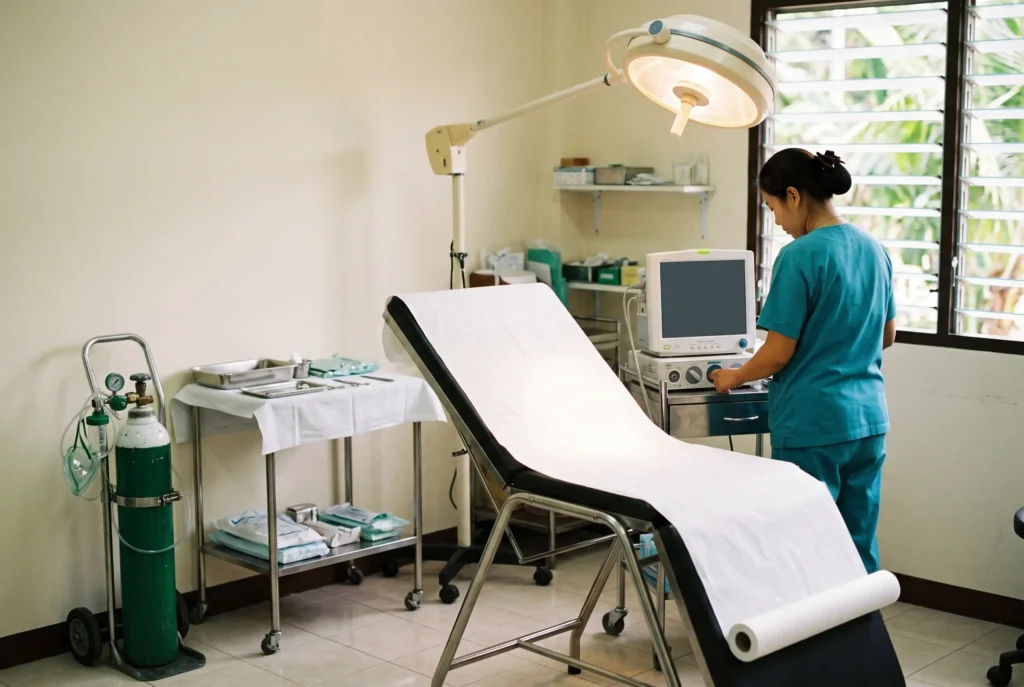
The thing that makes urgent problems harder here is not the medicine. It is the geography. There is no hospital on the peninsula, no road off it, and no ambulance that can reach you. Urgent medical care in Railay therefore means two jobs at once: treating what is in front of us, and working out fast whether this can be finished here or needs to cross the water.
What counts as urgent
Same-day rather than same-hour: a fever above 38C that has not settled, a wound that needs closing, an injury you cannot weight-bear on, vomiting that will not stop, a bite from anything with teeth, a rash spreading quickly, or an infection that looked fine yesterday and does not today.
None of those are emergencies in the ambulance sense. All of them get materially worse if left for a few days, which on Railay is exactly what tends to happen.
What is an actual emergency
Call 1669 immediately, and call us at the same time, for any of these:
- Chest pain, or pain spreading to the arm or jaw
- Breathlessness while sitting still
- Face drooping, arm weakness or slurred speech
- A head injury followed by vomiting, confusion or drowsiness
- Bleeding that does not stop with firm pressure
- A seizure, or anyone who cannot be woken
- A severe allergic reaction with swelling of the lips, tongue or throat
Do not wait to see whether it settles, and do not start walking to the boats to save time. Make the two calls first — that is what starts the machinery moving on both sides of the water.
Why calling us at the same time helps
1669 dispatches an ambulance, and the ambulance cannot come to Railay. It comes to a pier on the mainland.
Somebody has to arrange the boat that gets you to that pier, and to tell the receiving hospital what is coming so the right team is standing by. Those two things happen in parallel with the ambulance call rather than after it, which is the single biggest thing that changes how long the whole chain takes.
It also means the boat is not being negotiated by a frightened traveller with no Thai, at night, on a beach.
What we can stabilise on the peninsula
A good deal, and enough to change outcomes. Oxygen, IV fluids and IV medication, adrenaline for anaphylaxis, control of serious bleeding, splinting, wound closure with stitches, nebulised treatment for an asthma attack, and blood tests that tell us how sick somebody actually is rather than how sick they look.
Looking well is unreliable in exactly the cases that matter. Someone with early dengue or a developing skin infection can hold a normal conversation while their bloods say something quite different.
What we cannot do, stated plainly
There is no X-ray here, no CT scanner, no operating theatre, no blood bank and no inpatient bed. Anything needing imaging, surgery, transfusion or admission is going to Krabi Town.
We would rather tell you that in the first five minutes than in the fortieth. If a broken bone needs an X-ray, the answer is a crossing, and the useful question becomes how fast and how comfortably rather than whether.
What we can do is make the crossing count. Splinting a limb properly before it moves, controlling pain so the boat is bearable, putting a line in so fluids are already running on arrival, and sending an English written summary of what we found and what we gave — so the hospital starts from our examination rather than from scratch. On a transfer that takes the best part of two hours, that groundwork is most of the value.
Overnight, and the honest version of after-hours
The clinic building is open 8am to 10pm. Outside those hours we are reachable by phone, WhatsApp and Line, and a doctor is reachable overnight through our Ao Nang clinic.
What that gets you at two in the morning is an informed decision, which is usually the thing you actually need. Someone will tell you honestly whether this can wait until the clinic opens or whether it needs to move tonight — and if it needs to move, we start arranging it while you are getting dressed.
Boats after dark are possible but scarce, and stop entirely in bad weather. That is precisely why the middle-of-the-night message is worth sending rather than sitting on.
Children, and the low threshold we apply
We treat children, and we deliberately keep the bar for seeing them lower than for adults. Small children get dehydrated much faster in this heat, deteriorate more suddenly, and show fewer of the warning signs adults do.
Bring their approximate weight. Come earlier than you would for yourself. A child who has stopped drinking, has not passed urine in eight hours, is unusually floppy or drowsy, or has a rash that does not fade when pressed should be seen straight away rather than watched at the resort.
Trust your own read as well. A parent who says their child is simply not behaving like themselves is describing real clinical information, and we treat it that way rather than waiting for a number on a thermometer to justify the visit.
Frequently asked questions
What number do I call in an emergency in Thailand?
1669 for the national ambulance service. Call us at the same time on the clinic number so the boat and the ambulance are arranged in parallel.
Can an ambulance reach Railay?
No. There are no roads onto the peninsula. Any transfer is by longtail boat to a mainland pier, where an ambulance meets you.
What if this happens at 3am?
Message us. Someone answers and a doctor is reachable overnight, and you will get a straight answer about whether it waits until morning or moves tonight.
Do you have oxygen and emergency medication?
Yes — oxygen, IV fluids and medication, adrenaline, and equipment for controlling serious bleeding.
Can you do an X-ray?
No. There is no imaging on the peninsula. If a fracture needs confirming, that means a crossing to Krabi Town, and we arrange it.
Will my travel insurance cover an evacuation?
Usually, but check whether your policy excludes rock climbing before you need to find out. Read travel insurance claims first — many standard policies exclude it outright.
Should I go straight to the boats myself?
Call first. It takes thirty seconds and often changes the plan — sometimes you can be treated here, and when you cannot, we can have the crossing and the hospital arranged before you have finished packing.
Who treats you here, and who is behind them
The clinic on Railay is run by experienced English-speaking nurses. Behind them sits Doctor Ao Nang Takecare Medical Clinic in Ao Nang, which Takecare Clinic Railay works together with as one service rather than two businesses: shared doctors, shared records, shared treatment plans. In practice that means a doctor is pulled in the moment your case needs one — to review it, to prescribe, or to come across to the peninsula in person. If you later cross to the mainland, whoever sees you is already holding your notes and you are not starting the story again. It also means the second opinion that would otherwise cost you a boat and half a day costs a phone call.
Getting seen
Opening hours are 8am–10pm daily. Outside them we are still reachable 24 hours by phone, WhatsApp and Line, so when something happens at eleven at night the right move is to message us, not to lie awake deciding whether it can wait. No appointment is needed at any point — walk in, or reach us on +66 81 718 9080, WhatsApp or Line. If you would rather not move, ask for a doctor resort visit and we will come to you. And if this turns out to be something the peninsula cannot handle, that call is also how the boat and the hospital transfer start moving.