Urinary tract infection treatment in Railay
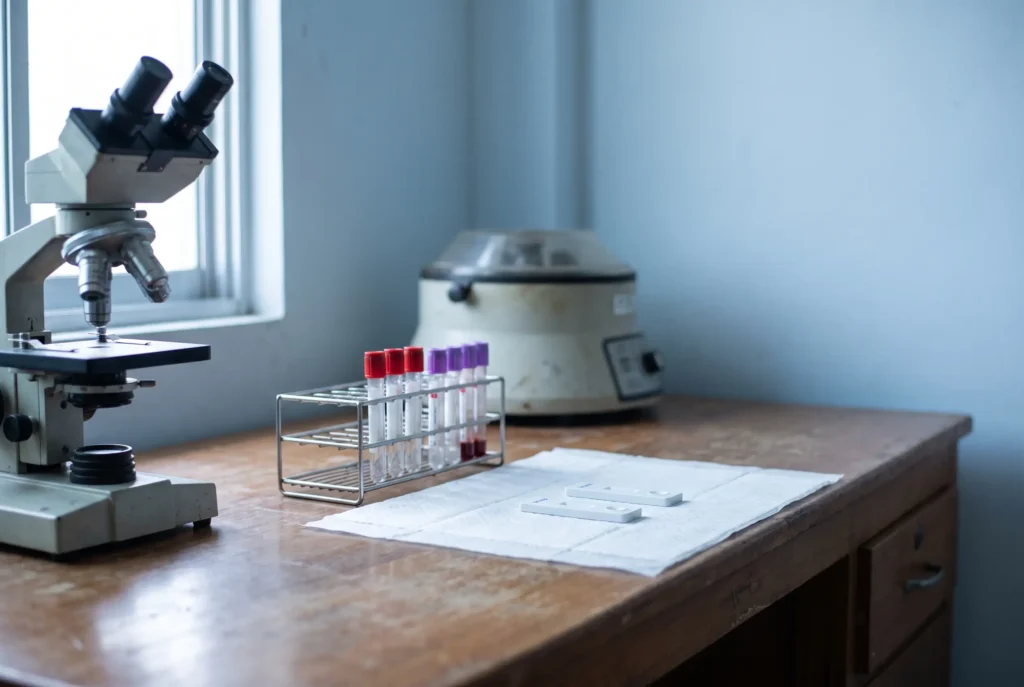
Burning when you pass urine, needing to go constantly, and passing very little when you do. Urinary infections are commoner in travellers than at home — heat, dehydration and long days without a decent toilet all contribute. UTI treatment in Railay starts with a urine test that takes minutes, and most people are treated and improving within a day.
What it feels like
The typical picture:
- Burning or stinging when passing urine
- Needing to go frequently and urgently
- Passing only small amounts despite the urgency
- Lower abdominal discomfort or pressure
- Cloudy, strong-smelling urine
- Occasionally blood in the urine
Without fever and without back pain, this is almost always a simple bladder infection, which responds quickly to a short course of antibiotics.
Why travellers get more of them
Dehydration is the main driver. In this heat you lose a great deal through sweat, so urine becomes concentrated and you pass it less often — and flushing the bladder regularly is one of the main defences against infection.
Then behaviour. People hold on for hours because there is nowhere acceptable to go: on a boat, at a crag, on a long day out. Holding urine gives bacteria time to multiply.
Add sex, which is a well-established trigger in women, plus swimming in warm water, damp swimwear worn for hours, and a disrupted routine. A long climbing day on Railay combines almost all of these at once.
There is a specific version of this we see repeatedly. A full day at a crag with no toilet anywhere near it, deliberately drinking less so as not to need one, several hours in the heat, and a walk back in the late afternoon. Everything about that day pushes in the same direction, and the symptoms usually announce themselves that evening or the following morning.
Testing, which takes minutes
A urine dipstick gives an answer in a couple of minutes — it detects the nitrites and leucocytes that indicate infection, plus blood and protein.
That matters because burning on urination is not always an infection. It can be irritation, thrush, or a sexually transmitted infection — chlamydia in particular causes exactly these symptoms and is treated completely differently. See STD testing.
Where the picture is unclear or infections keep returning, the sample can go for culture to identify the organism and its sensitivities. That takes a few days, and we will say honestly whether waiting changes what we would do.
Treatment, and drinking properly
A short course of antibiotics — usually three days for a simple bladder infection in a woman, longer for men or anything complicated. Most people notice improvement within twenty-four hours.
Drink considerably more than usual, and do it deliberately. Two to three litres a day in this climate is reasonable, and it is genuinely part of the treatment rather than general advice.
Paracetamol or ibuprofen for the discomfort. Urinary alkalinising sachets ease the burning. Cranberry has some evidence for prevention and essentially none for treating an established infection — it is not a substitute for antibiotics.
Finish the course even after the symptoms have gone, which they usually do well before the infection is cleared. A three-day course abandoned on day two is the commonest reason an infection returns within a fortnight, and the returning one is often harder to treat than the original. This matters more on a peninsula than it would at home, because a relapse means another boat, another consultation and possibly a longer course.
Kidney involvement, the one to catch
An untreated bladder infection can ascend to the kidney, which is a considerably more serious illness. Come in the same day for:
- Fever and chills
- Pain in the back or side, usually one-sided
- Nausea and vomiting
- Feeling genuinely unwell rather than uncomfortable
- Confusion, particularly in older patients
That needs longer antibiotics, often intravenous, and sometimes admission in Krabi Town — see evacuation and hospital transfer. It is the reason a UTI is not something to leave for a few days on a peninsula where leaving is a two-hour operation.
Men, and why it is treated differently
Urinary infections are much less common in men, and a UTI in a man is never assumed to be simple.
The course is longer, and prostate involvement is considered — which presents with pelvic or perineal pain, difficulty starting, and sometimes fever. That needs a longer course of an antibiotic that penetrates prostate tissue.
A man with urinary symptoms also warrants thinking harder about sexually transmitted infection, because urethritis from chlamydia or gonorrhoea produces very similar symptoms and a dipstick alone does not distinguish them.
Preventing the next one
Drink enough that your urine is pale rather than dark. That single measure prevents more infections than everything else combined, and in this climate it takes deliberate effort rather than good intentions.
Do not hold on for hours. Pass urine after sex. Get out of wet swimwear rather than letting it dry on you. Wipe front to back.
If you get them repeatedly, it is worth investigating rather than treating each episode in isolation — see health check up. And if you are here for a season and prone to them, carrying rehydration sachets for long hot days is a small habit with a real effect.
Frequently asked questions
How quickly can you test for a UTI?
A urine dipstick gives an answer in a couple of minutes, in the same visit.
How long do antibiotics take to work?
Most people improve within twenty-four hours. Finish the course anyway.
Could it be something else?
Yes — thrush, irritation, or chlamydia, which causes very similar symptoms and needs different treatment. That is why we test rather than assume.
Does cranberry juice work?
Some evidence for prevention, essentially none for treating an established infection. It is not a substitute for antibiotics.
When is it an emergency?
Fever, one-sided back pain, vomiting, or feeling genuinely unwell. That suggests kidney involvement and needs the same day.
Why do I keep getting them here?
Usually dehydration plus holding on for hours. Concentrated urine passed infrequently is the main risk factor, and this climate produces both.
Can a doctor come to me?
Yes — a doctor resort visit, though a urine test at the clinic gives a faster and more definite answer.
Can I still swim and climb while being treated?
Climbing is fine once you feel up to it. Swimming is fine too, provided you change out of wet swimwear promptly rather than sitting in it for the afternoon, since that is one of the things that contributed in the first place.
Who treats you here, and who is behind them
The clinic on Railay is run by experienced English-speaking nurses. Behind them sits Doctor Ao Nang Takecare Medical Clinic in Ao Nang, which Takecare Clinic Railay works together with as one service rather than two businesses: shared doctors, shared records, shared treatment plans. In practice that means a doctor is pulled in the moment your case needs one — to review it, to prescribe, or to come across to the peninsula in person. If you later cross to the mainland, whoever sees you is already holding your notes and you are not starting the story again. It also means the second opinion that would otherwise cost you a boat and half a day costs a phone call.
Getting seen
Opening hours are 8am–10pm daily. Outside them we are still reachable 24 hours by phone, WhatsApp and Line, so when something happens at eleven at night the right move is to message us, not to lie awake deciding whether it can wait. No appointment is needed at any point — walk in, or reach us on +66 81 718 9080, WhatsApp or Line. If you would rather not move, ask for a doctor resort visit and we will come to you. And if this turns out to be something the peninsula cannot handle, that call is also how the boat and the hospital transfer start moving.