Wound Dressing in Railay
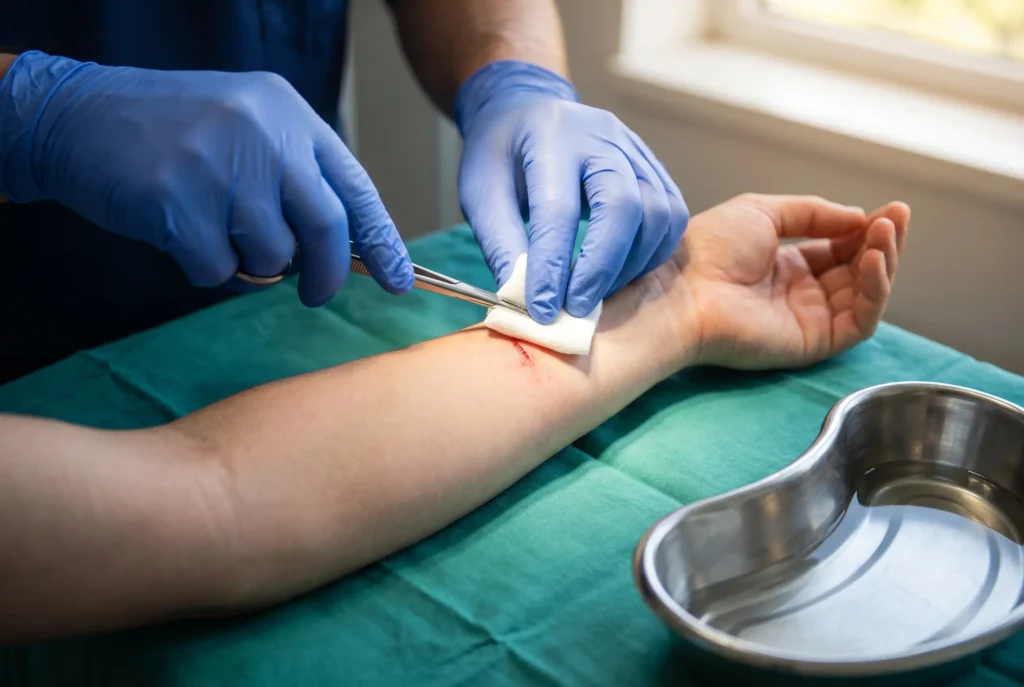
A wound that would heal without incident at home has a much harder time on a tropical peninsula. Heat, humidity, seawater, sand and sweat all work against it, and the thing that decides how it turns out is usually not the original injury but what happens over the following week. Wound dressing in Railay is available daily, and you are welcome whether or not we treated the wound in the first place.
Why wounds behave badly in this climate
Bacteria multiply faster in heat. Humidity keeps dressings damp, and a damp dressing stops being a barrier and starts being a culture medium. Sweat lifts adhesive, so tape that held for a day at home peels here by lunchtime.
Then there is the sea. Everybody swims, and warm coastal water carries organisms — including Vibrio species — that cause infections rarely seen in temperate countries and that move quickly once established.
The practical consequence is that the interval between dressing changes should be shorter here than you are used to, and the threshold for having somebody look at a wound should be lower.
What a proper dressing change involves
Removing the old dressing without tearing new tissue, cleaning the wound rather than merely wiping the skin around it, inspecting the base for debris and signs of infection, and choosing a dressing that suits what the wound is doing now rather than what it was doing three days ago.
That last point is where most self-managed wounds go wrong. A wound that is oozing needs an absorbent dressing; the same wound four days later needs something that keeps it moist rather than drying it out. Using one dressing for the whole course produces either maceration or a scab that cracks open every time you move.
Where a wound is deep or has a cavity, it needs packing rather than covering. A cavity closed at the surface with infection sealed inside is a predictable abscess — see minor surgery.
The signs that mean today rather than tomorrow
Come in the same day for any of these:
- Redness spreading outward from the wound edges
- Increasing pain after day two, when it should be easing
- Yellow or green discharge, or a smell
- Warmth and swelling around the area
- A red line tracking away from the wound
- Fever, chills, or feeling generally unwell
Spreading redness is the one to act on. It is cellulitis, it does not resolve on its own, and treated early it is oral antibiotics while treated late it is intravenous antibiotics in Krabi Town.
Wounds we see most on the peninsula
Coral and limestone cuts, which look trivial and are the most reliably troublesome wounds here because of what gets left in them.
Rock abrasions from climbing, rope burns, cuts on boat propellers and rusted fittings, burns from motorbike exhausts collected before arriving on Railay, urchin spine punctures, and surgical wounds that people are travelling with.
We also see a steady number of wounds treated somewhere else that have simply not been looked at since, which is exactly what a daily dressing service exists for.
Keeping a wound dry when everything is wet
The honest advice is that a healing wound and daily swimming are not compatible, and most people would rather hear a workable compromise than a rule they will ignore.
Waterproof dressings help but do not survive an hour in the sea; assume water gets in and change the dressing straight after swimming rather than at bedtime. Keep it dry and open to air overnight where the wound allows, because a night of drying does more good than another twelve hours under damp gauze.
Sand is worse than water. A wound that has had sand in it needs proper irrigation rather than a rinse, and that is worth walking in for.
Tetanus, which people forget until it is mentioned
Any wound contaminated with soil, sand, rust or animal saliva raises the question of tetanus, and most travellers cannot remember their last booster.
Protection lasts about ten years. If you are outside that window, or genuinely do not know, having the booster is quick, inexpensive and settles it — see travel vaccinations.
If the wound came from an animal, tetanus is only half the question. The other half is rabies, and that clock starts immediately — see rabies vaccination.
Coming in daily, and what it costs
Dressing changes are inexpensive and you do not need an appointment. Come in during opening hours and someone will see you.
If you were treated elsewhere — in Krabi Town, in another country, or by a well-meaning friend with a first aid kit — that is fine. Bring any paperwork you have, and tell us what was used, particularly if you were given antibiotics and when they were started.
If you cannot walk, dressings can be changed at your resort as part of a doctor resort visit, though for anything needing careful work the clinic’s light and sterile field give a better result.
Frequently asked questions
How often should a dressing be changed here?
More often than at home — usually daily, and immediately after it gets wet or sandy. Heat and humidity turn a damp dressing into a problem rather than a barrier.
Can you dress a wound you did not treat?
Yes, and it is a large part of what we do. Bring any paperwork and tell us what has been used so far.
How much does a dressing change cost?
It is one of the cheaper things we do, and you are told the price before it is done.
Can I swim with a wound?
While it is open, not really. Waterproof dressings do not survive the sea for long — assume water gets in and change the dressing straight afterwards.
How do I know it is infected?
Spreading redness, increasing pain after day two, discharge, warmth, a red line tracking away, or fever. Any of those means the same day rather than tomorrow.
Do I need a tetanus jab?
If your last booster was more than ten years ago, or you cannot remember, yes — particularly for wounds involving sand, soil, rust or animals.
Will it scar?
Some scarring is inevitable with any wound that goes through the full thickness of skin, but proper cleaning, correct closure and keeping infection out make a large difference. Sun on a fresh scar darkens it, so keep it covered.
Who treats you here, and who is behind them
The clinic on Railay is run by experienced English-speaking nurses. Behind them sits Doctor Ao Nang Takecare Medical Clinic in Ao Nang, which Takecare Clinic Railay works together with as one service rather than two businesses: shared doctors, shared records, shared treatment plans. In practice that means a doctor is pulled in the moment your case needs one — to review it, to prescribe, or to come across to the peninsula in person. If you later cross to the mainland, whoever sees you is already holding your notes and you are not starting the story again. It also means the second opinion that would otherwise cost you a boat and half a day costs a phone call.
Getting seen
Opening hours are 8am–10pm daily. Outside them we are still reachable 24 hours by phone, WhatsApp and Line, so when something happens at eleven at night the right move is to message us, not to lie awake deciding whether it can wait. No appointment is needed at any point — walk in, or reach us on +66 81 718 9080, WhatsApp or Line. If you would rather not move, ask for a doctor resort visit and we will come to you. And if this turns out to be something the peninsula cannot handle, that call is also how the boat and the hospital transfer start moving.