Dengue fever treatment in Railay
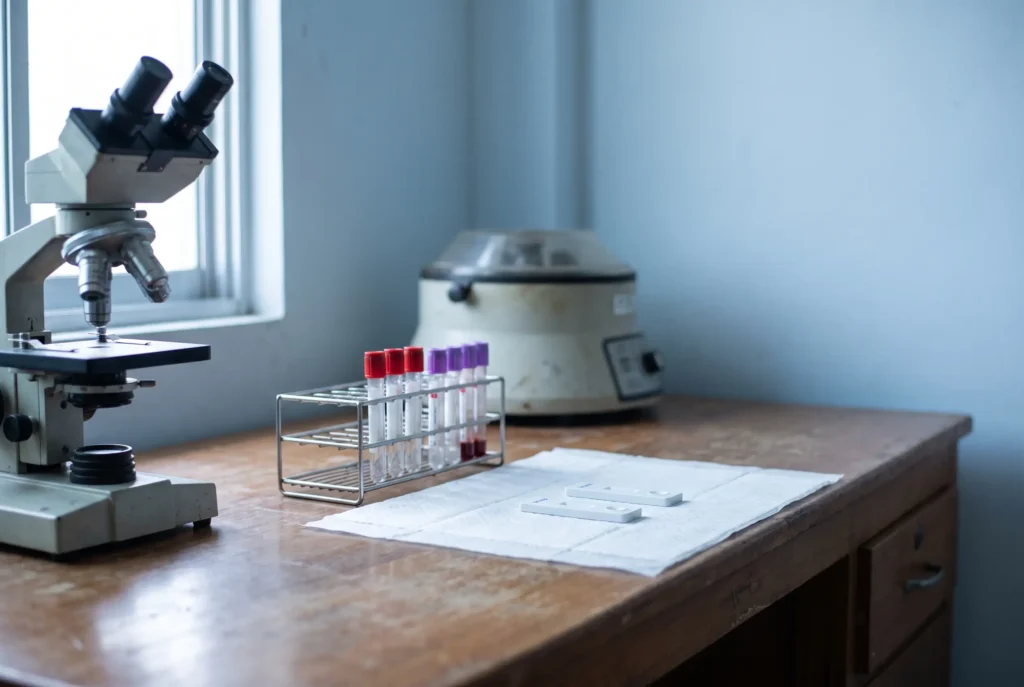
A fever that arrives suddenly, a headache behind the eyes, and an ache deep in the bones that has earned dengue the name breakbone fever. It is the mosquito-borne illness travellers in Krabi actually meet, and dengue fever treatment in Railay starts with a same-visit blood test — because the most important thing about dengue is what you must not take for it.
What it feels like
The onset is abrupt rather than gradual. One afternoon you are fine; by evening you have a high fever and feel genuinely awful.
- Sudden high fever, often 39 to 40C
- Severe headache, characteristically behind the eyes
- Deep muscle and joint pain
- Nausea and vomiting
- A blotchy red rash, usually from day three or four
- Exhaustion out of proportion to everything else
The tiredness is the part people are unprepared for. It commonly outlasts the fever by weeks, and it is not something you push through with willpower.
Never take ibuprofen or aspirin
This is the single most important sentence on this page.
Dengue lowers your platelet count, which is what makes blood clot. Ibuprofen, aspirin and other anti-inflammatories also impair clotting and irritate the stomach lining. Taken together with dengue, they meaningfully increase the risk of serious bleeding.
Paracetamol is the correct painkiller, and it works reasonably well. The problem is that dengue feels exactly like the flu people normally treat with ibuprofen, so travellers reach for precisely the wrong thing — which is the strongest argument for testing rather than assuming.
Testing, and why it is quick here
We run the dengue NS1 antigen test and antibody tests, with a result in about fifteen to thirty minutes.
NS1 detects the virus itself and is most reliable in the first five days, which is usually when people come in. Antibody tests become useful later. Alongside that we run a full blood count, and the platelet number from that is what actually guides the next few days.
A same-visit result matters more here than it would elsewhere. Being told to come back tomorrow means a boat, and the interval between day three and day five of dengue is exactly when things either settle or do not.
The critical phase, which arrives as the fever breaks
This is the part that surprises people, and it is the reason dengue is monitored rather than simply endured.
Around day three to seven, as the fever comes down, some patients enter a phase where blood vessels leak and platelets fall further. It happens exactly when the patient feels they are getting better, which is why deterioration is missed.
Warning signs during that window need immediate attention: severe abdominal pain, persistent vomiting, bleeding from gums or nose, blood in vomit or stool, extreme lethargy or restlessness, cold clammy skin, or rapid breathing. Any of those means hospital, which from here means a crossing — see evacuation and hospital transfer.
How it is managed
There is no antiviral for dengue. Treatment is supportive, and done properly it is highly effective — the overwhelming majority of people recover fully.
That means paracetamol for fever and pain, aggressive attention to fluids, and monitoring. Where somebody cannot keep fluids down, an IV drip does the job the stomach cannot. Repeat blood counts track the platelets, and the trend matters more than any single number.
Rest is not advice, it is the treatment. People who try to carry on climbing through dengue take considerably longer to recover.
Where somebody is well enough to stay on the peninsula, we monitor them here with repeat testing every day or two rather than admitting them anywhere. That works well for most cases and it means you recover in your own room instead of a ward two hours away. What it depends on is you actually coming back for the repeat count — the trend across three days is the thing that decides whether this stays a clinic problem or becomes a hospital one, and a single reassuring number on day two proves very little on its own.
The second infection problem
There are four dengue serotypes. Recovering from one gives lifelong immunity to that serotype and only brief protection against the others.
A second infection with a different serotype carries a higher risk of severe dengue than the first. This matters for anyone who has had dengue before, particularly people who spend seasons in Southeast Asia and treat a previous infection as protection. It is closer to the opposite.
If you have had dengue previously and now have a fever, say so — it lowers the threshold for testing and for monitoring closely.
Not being bitten in the first place
The mosquito that carries dengue, Aedes aegypti, bites during the day, with peaks around dawn and late afternoon. That is not the mosquito behaviour most travellers plan around.
Use repellent containing DEET or picaridin on exposed skin and reapply after swimming and sweating. Cover up at dawn and dusk. Use air conditioning or a fan, since mosquitoes struggle in moving air. They breed in small volumes of standing water, so buckets, plant saucers and blocked drains around a bungalow are the source rather than the jungle.
There is no dengue vaccine available to most travellers. Bite avoidance is the whole of the prevention, and it is worth taking seriously — see insect bite treatment for bites that become infected.
Frequently asked questions
How quickly can you test for dengue?
About fifteen to thirty minutes for the result, in the same visit.
Can I take ibuprofen for the pain?
No. Ibuprofen and aspirin increase bleeding risk in dengue. Paracetamol only.
How long does dengue last?
The fever usually runs about a week. The exhaustion commonly lasts several weeks longer, and that part cannot be rushed.
When do I need a hospital?
Severe abdominal pain, persistent vomiting, any bleeding, extreme lethargy, or cold clammy skin. Those mean a crossing to Krabi Town without delay.
Can I get dengue twice?
Yes — there are four serotypes, and a second infection with a different one carries a higher risk of severe disease.
Is there a vaccine?
Not one available to most travellers. Avoiding bites is the prevention.
Can I fly home with dengue?
Not during the critical phase. Ask us first — flying while platelets are falling is a poor idea, and we can advise on timing.
Is dengue contagious between people?
No. It passes only through mosquito bites, so you cannot catch it from someone you are sharing a room with. What you can share is the mosquito, which is why a second case in the same group usually follows a few days behind the first.
Who treats you here, and who is behind them
The clinic on Railay is run by experienced English-speaking nurses. Behind them sits Doctor Ao Nang Takecare Medical Clinic in Ao Nang, which Takecare Clinic Railay works together with as one service rather than two businesses: shared doctors, shared records, shared treatment plans. In practice that means a doctor is pulled in the moment your case needs one — to review it, to prescribe, or to come across to the peninsula in person. If you later cross to the mainland, whoever sees you is already holding your notes and you are not starting the story again. It also means the second opinion that would otherwise cost you a boat and half a day costs a phone call.
Getting seen
Opening hours are 8am–10pm daily. Outside them we are still reachable 24 hours by phone, WhatsApp and Line, so when something happens at eleven at night the right move is to message us, not to lie awake deciding whether it can wait. No appointment is needed at any point — walk in, or reach us on +66 81 718 9080, WhatsApp or Line. If you would rather not move, ask for a doctor resort visit and we will come to you. And if this turns out to be something the peninsula cannot handle, that call is also how the boat and the hospital transfer start moving.