HIV Testing in Railay
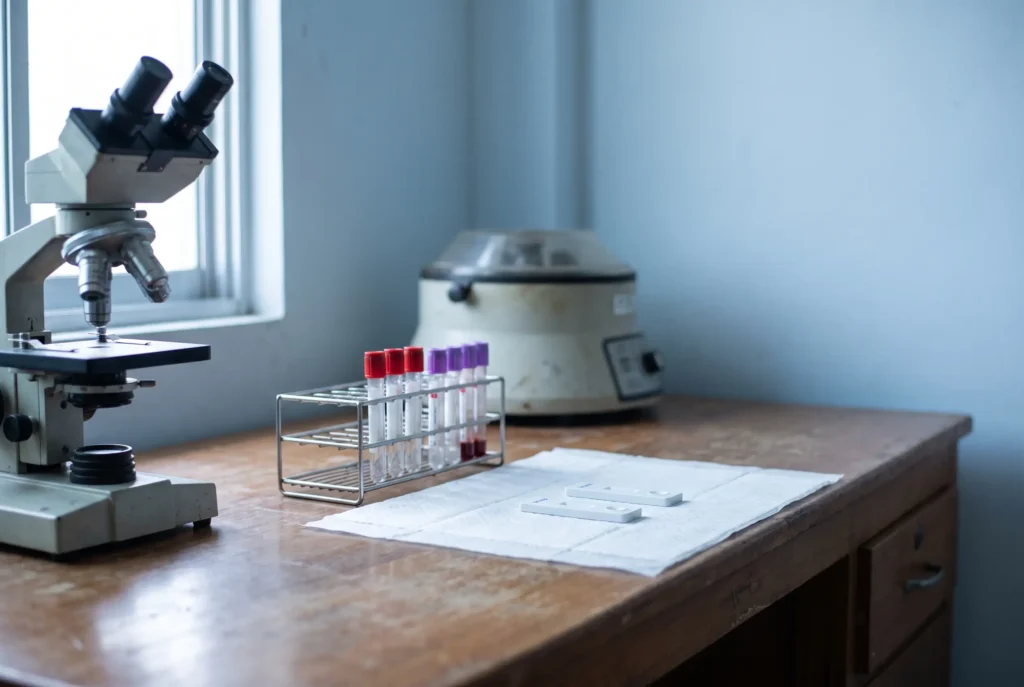
A rapid HIV test takes a finger-prick of blood and about twenty minutes, and you get the result in the room rather than by phone three days later. HIV testing in Railay is confidential, walk-in, and — for the great majority of people who come in worried — ends with a negative result and a much better night’s sleep.
How the test works
A small drop of blood from a finger prick, applied to a test cassette, read at twenty minutes. That is the whole procedure.
We use a fourth-generation test, which looks for both HIV antibodies and the p24 antigen. The antigen appears earlier in infection than antibodies do, which is what shortens the window period from twelve weeks down to about four — a meaningful difference when you are waiting.
You wait in the clinic while it runs. There is no advantage to going away and coming back, and most people would rather not carry the question around town for an afternoon.
The window period, and why it decides everything
A test cannot detect an infection that has not yet produced anything to detect. The interval between exposure and detectability is the window period, and misunderstanding it causes more distress than the tests themselves.
With a fourth-generation test, most infections are picked up from about four weeks after exposure. It is considered conclusive at six to twelve weeks. Before four weeks, a negative result tells you about your status before the exposure you are worried about, not after it.
That does not make early testing useless — a baseline is genuinely worth having, particularly if you are going to be tested again. It means we will tell you plainly what today’s result covers and give you a date to come back for one that settles it.
If the exposure was in the last 72 hours
Then testing is not the priority and time is. PEP — post-exposure prophylaxis — is a month-long course of antiviral medication that can stop HIV establishing itself, and it has a hard cut-off at 72 hours.
Effectiveness falls with every hour of delay, so ideally it starts within a few hours rather than on day three. If you are reading this and the exposure was recent, come in now rather than after you have finished thinking about it — see PEP and PrEP.
Being on a peninsula makes this more urgent rather than less. If the boats stop and you have to wait until morning, you have spent a meaningful fraction of your window on the water rather than on treatment.
What a reactive result actually means
A rapid test that comes back reactive is not a diagnosis. It is a screening result that requires a confirmatory laboratory test before it means anything at all, and false positives do occur.
If that happens, we arrange the confirmatory test immediately rather than leaving you holding an unconfirmed result over a weekend, and we tell you what the next steps look like in either direction. Nobody is sent out of the door with a piece of paper and a recommendation to see someone at home.
And the fact worth stating clearly: HIV in 2026 is a manageable long-term condition with ordinary life expectancy on treatment, and treatment is available and affordable in Thailand. The diagnosis people fear is not the diagnosis that exists now.
Confidentiality, on a peninsula where everyone sees everyone
Results go to you and to nobody else. Not your resort, not your travel insurer without your consent, not anyone you are travelling with, and not Thai immigration.
You are seen like any other patient, and no reason for the visit is stated anywhere anybody else can see. If you would rather the receipt did not itemise an HIV test, say so and it will read as a consultation and blood test, which is accurate.
HIV testing has no bearing on your Thai visa and is not reported to any authority. That question comes up constantly and deserves a direct answer rather than reassurance.
Who should test, beyond the obvious
Anyone after unprotected sex with a new partner, anyone whose condom broke, and anyone who has shared needles for any purpose, including steroid use and cosmetic injections.
Also: anyone who has had a tattoo or piercing somewhere the sterilisation looked uncertain, anyone who has had a medical or dental procedure in a setting they were not confident about, and anyone with a new diagnosis of another sexually transmitted infection — because the risk factors overlap heavily. See STD testing for the wider panel.
And anyone who simply wants to know. That is a sufficient reason on its own, and a large proportion of the tests we run are for exactly that.
Long-stay workers are the group that most often puts it off. If you have been on the peninsula for a season, testing once is a twenty-minute job that removes a question you have probably been carrying for months, and it is worth doing on a quiet morning rather than after a scare.
PrEP, if this is going to keep happening
If you find yourself worrying about this repeatedly, testing after the fact is treating the anxiety rather than the risk. PrEP is medication taken before exposure that is extremely effective at preventing HIV.
It is straightforward to start, widely used in Thailand, and involves a baseline test plus kidney function checks. For someone spending a season here, it is a considerably better arrangement than a rapid test every few weeks.
PrEP prevents HIV and nothing else, so testing for other infections continues alongside it. See PEP and PrEP for how both work.
Frequently asked questions
How long does the result take?
About twenty minutes, and you wait in the clinic for it.
How soon after exposure is a test reliable?
A fourth-generation test detects most infections from about four weeks, and is considered conclusive at six to twelve.
Is it confidential?
Yes. The result goes to you alone — not to your resort, your travel companions or Thai immigration.
Does it affect my visa?
No. HIV testing here is not reported to immigration and has no bearing on your visa.
What if the test is reactive?
It is a screening result, not a diagnosis, and needs laboratory confirmation. We arrange that immediately rather than leaving you waiting.
The exposure was yesterday — should I test?
Test if you want a baseline, but the urgent matter is PEP, which must start within 72 hours. Come in today.
How much does it cost?
A rapid HIV test is inexpensive and quoted before it is done.
Who treats you here, and who is behind them
The clinic on Railay is run by experienced English-speaking nurses. Behind them sits Doctor Ao Nang Takecare Medical Clinic in Ao Nang, which Takecare Clinic Railay works together with as one service rather than two businesses: shared doctors, shared records, shared treatment plans. In practice that means a doctor is pulled in the moment your case needs one — to review it, to prescribe, or to come across to the peninsula in person. If you later cross to the mainland, whoever sees you is already holding your notes and you are not starting the story again. It also means the second opinion that would otherwise cost you a boat and half a day costs a phone call.
Getting seen
Opening hours are 8am–10pm daily. Outside them we are still reachable 24 hours by phone, WhatsApp and Line, so when something happens at eleven at night the right move is to message us, not to lie awake deciding whether it can wait. No appointment is needed at any point — walk in, or reach us on +66 81 718 9080, WhatsApp or Line. If you would rather not move, ask for a doctor resort visit and we will come to you. And if this turns out to be something the peninsula cannot handle, that call is also how the boat and the hospital transfer start moving.