Suture Removal in Railay
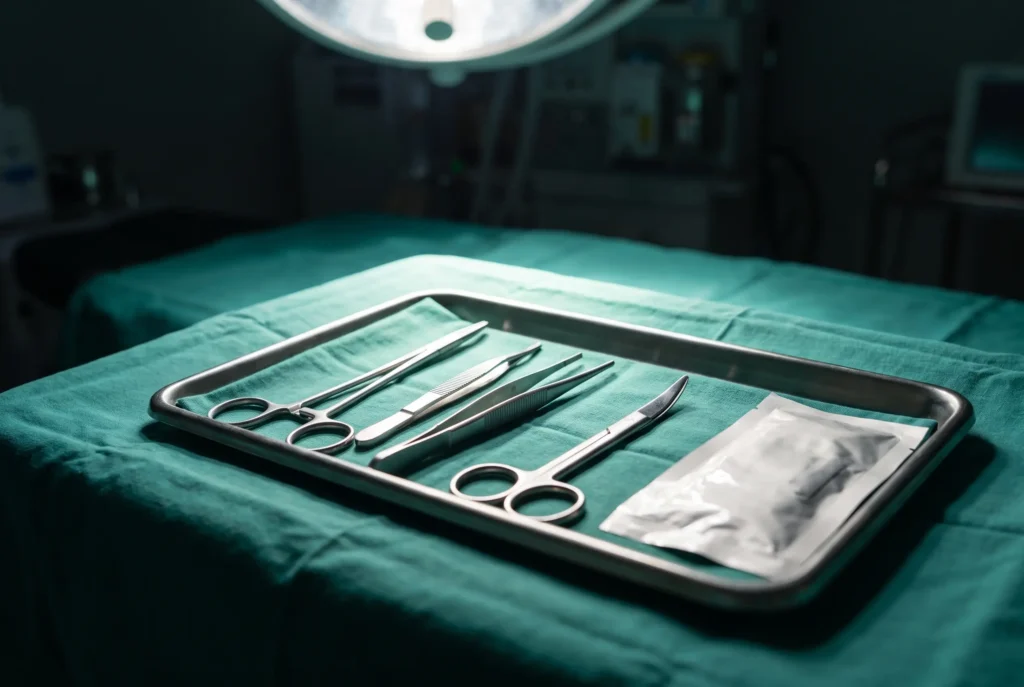
Stitches have to come out on time. Too early and the wound opens; too late and the skin grows around the thread, leaving the little railway-track marks that people associate with bad scars. Suture removal in Railay takes a few minutes, costs very little, and we do it whether or not the stitches were ours.
When yours are due out
Timing is by body site rather than by how the wound looks, because different sites are under very different tension:
- Face and neck — 5 days
- Scalp — 7 to 10 days
- Chest, back and abdomen — 10 to 14 days
- Arms — 7 to 10 days
- Legs — 10 to 14 days
- Hands, feet and across any joint — 10 to 14 days
Face is short deliberately. Facial skin heals quickly and its blood supply is excellent, so five days is enough — and every extra day is another day of the thread marking skin that is going to be on display.
Stitches put in somewhere else
Entirely routine, and a good share of what we remove. People arrive having been treated in Krabi Town, in Bangkok, on another island, or before they ever came to Thailand.
Bring whatever paperwork you have. If you have none, that is workable — we can usually tell the material and the technique by looking, and the important information is the date they went in and roughly where the wound is.
If you genuinely cannot remember the date, say so rather than guessing. We would rather assess the wound and decide than remove on the strength of a bad estimate.
What happens, and whether it hurts
Very little, and no. The area is cleaned, each stitch is lifted with forceps, cut on one side below the knot, and drawn out. It feels like a small tug.
The reason it is painless is that the thread is pulled through the side that was outside the skin, so nothing that has been sitting in the wound is dragged back through it. That is also why cutting your own stitches with nail scissors is a bad idea — it usually pulls the dirty external portion straight through the healing track.
The whole thing takes a few minutes. Most people are surprised it was worth the walk.
Why not to do it yourself
People do, particularly when a departure is looming, and the results come back to us.
The three failures are all common: cutting on the wrong side and pulling contaminated thread through the wound, missing a stitch entirely and leaving it buried until it forms a small abscess weeks later, and removing everything on day four because the wound “looks fine” and then watching it open.
A wound that has been closed for a week is not a wound that has healed. At the point stitches come out, the repair has perhaps ten per cent of its final strength.
The other reason to come in is that removal is the only time anybody looks at the wound properly with the thread gone. Problems that were hidden underneath the stitches — a small pocket of infection, a fragment of grit still sitting in the track, edges that have not knitted at one end — are visible for about thirty seconds and easy to deal with at that moment. Found a week later at home, the same things are a course of antibiotics and a worse scar.
What we check while they are out
Whether the wound edges are holding once the support is gone, whether there is any sign of infection, whether anything is still buried in it, and whether the scar is behaving normally for its age.
If the edges look likely to separate — common over knuckles, knees and anywhere that bends — we support the line with adhesive strips for a further few days. That is a small intervention that regularly saves a scar from stretching.
Anything that looks infected gets treated then and there rather than sent away, and if redness is spreading outward that is cellulitis and needs antibiotics the same day.
Looking after the scar afterwards
The first three months decide how the scar ends up, and the two things that matter most are sun and tension.
Keep it covered or under high-factor sunscreen. A fresh scar exposed to Thai sun pigments darkly and permanently, and this is by far the commonest avoidable cause of an ugly result in travellers. Avoid stretching the line — no heavy loading through a hand scar, no deep bending through a knee scar, for a few weeks.
Silicone gel or sheeting helps if the scar is thickening. Massaging it gently once it is fully closed helps it soften. Neither is urgent on the day the stitches come out.
If you are leaving before they are due
Not a problem, and not a reason to have them out early. Any clinic anywhere in the world removes stitches, and it is a cheap and quick procedure everywhere.
We will give you the removal date in writing along with the site and the material used, which is all the next clinic needs. If your flight is long-haul, keep the wound covered and dry through the journey and change the dressing on arrival.
If in doubt, come and see us before you fly rather than after you land.
Frequently asked questions
Can you remove stitches put in at another clinic?
Yes, including ones put in abroad. Bring any paperwork you have, though we can manage without it.
Does it hurt?
No. Each stitch is cut and drawn out in a way that pulls nothing dirty back through the wound. It feels like a small tug.
How much does it cost?
Very little — it is one of the cheapest things we do, and you are told before we start.
What if I take them out myself?
We would rather you did not. The usual outcomes are a buried stitch that abscesses later, contaminated thread pulled through the wound, or a wound opened by removing them too early.
How do I know if it is too early?
Go by site and date rather than appearance. A wound looks healed several days before it has any real strength.
What if the wound opens after removal?
Come straight back. Usually it is supported with adhesive strips; occasionally it needs re-closing. Either way it is a same-day fix.
Can I swim once they are out?
Give it a couple of days for the puncture points to seal, then keep it out of the sun. Seawater on a scar that has only just closed is worth avoiding for a little longer.
Who treats you here, and who is behind them
The clinic on Railay is run by experienced English-speaking nurses. Behind them sits Doctor Ao Nang Takecare Medical Clinic in Ao Nang, which Takecare Clinic Railay works together with as one service rather than two businesses: shared doctors, shared records, shared treatment plans. In practice that means a doctor is pulled in the moment your case needs one — to review it, to prescribe, or to come across to the peninsula in person. If you later cross to the mainland, whoever sees you is already holding your notes and you are not starting the story again. It also means the second opinion that would otherwise cost you a boat and half a day costs a phone call.
Getting seen
Opening hours are 8am–10pm daily. Outside them we are still reachable 24 hours by phone, WhatsApp and Line, so when something happens at eleven at night the right move is to message us, not to lie awake deciding whether it can wait. No appointment is needed at any point — walk in, or reach us on +66 81 718 9080, WhatsApp or Line. If you would rather not move, ask for a doctor resort visit and we will come to you. And if this turns out to be something the peninsula cannot handle, that call is also how the boat and the hospital transfer start moving.